Can you imagine? In a laboratory at Harbin Institute of Technology, extreme weather conditions such as wind, rain, heat and snow can all be simulated. This is not a filming site for a science fiction movie, but a major national scientific research instrument development project, the “Joint Simulation Test System for the Entire Process of Wind, Rain, Heat and Snow in Large-Span Spatial Structures”.

Entering the wind Engineering laboratory of Harbin Institute of Technology, a scaled-down model of a gymnasium is undergoing the test of extreme weather:
In the cold wind of minus 15 degrees Celsius, artificial snow grains were swept into vortices by the fierce wind. The thermal radiation light array suddenly lit up, simulating the scorching midday sun. The rain nozzles spray ice rain simultaneously. This is precisely the daily test of the national major scientific research instrument development project “Wind-Rain-Heat-Snow Full-Process Joint Simulation Test System for Large-Span Spatial Structures”.
In recent years, extreme ice and snow disasters have occurred frequently around the world. Cold regions suffer from varying degrees of snow-induced engineering disasters every year. Due to the characteristics and wide application of large-span spatial structures, the consequences of snow-induced engineering disasters are even more severe. Professor Fan Feng from the School of Civil Engineering told the reporter. The snow load research team led by Professor Fan Feng has long been engaged in theoretical and practical research on snow loads. They have presided over the compilation of snow load chapters in standards such as the “Code for Loads on Building Structures” and the “General Code for Engineering Structures” in China, and published the first academic monograph on snow loads in buildings in China.

Traditional research on wind, rain and snow is like the blind men touching an elephant. Field measurements rely on natural conditions, numerical simulations are difficult to solve the phase change mechanism, and wind and snow experiments cannot reproduce the melting of snow under solar radiation. To clearly understand the entire process mechanism of the accumulation, melting, crystallization and re-accumulation of snow on the roof under the influence of environmental factors such as wind, rain and heat, to truly reproduce the snow environment on the roof of large-span spatial structures, and to solve the major problem of preventing snow-induced engineering disasters, Professor Fan Feng’s team, supported by the National Major Scientific Research Instrument Development Project, has developed this powerful tool for simulating extreme ice and snow climates.
This world’s first multi-factor coupled simulation system for building ice and snow environments – the “Joint Simulation Test System for the Entire Process of Wind, rain, heat and Snow in Large-Span Spatial Structures” – can be regarded as a “symphony orchestra” of climate phenomena:
Atmospheric boundary layer low-temperature wind tunnel: Capable of reproducing a low-temperature atmospheric wind field at -20℃
Intelligent snowfall module: Through the coordination of atomization by the nuclear device and the vibrating screen, the crystal form of snowflakes is controlled
Dual-mode rainfall system: The electromagnetic valve array precisely regulates the raindrop spectrum distribution
Solar radiation array: Infrared thermal radiation lamps simulate the intensity of sunlight at different latitudes
Monitoring the central nervous system: Real-time tracking of the phase change process of snowfall under the influence of wind-rain-heat environments
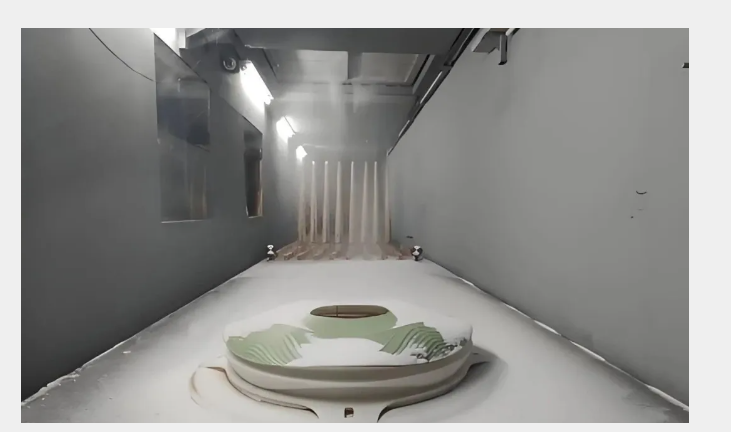
We have compressed the spatiotemporal scale of the natural climate. Associate Professor Zhang Qingwen from the School of Civil Engineering, a member of the team, pointed at the real-time monitoring screen and introduced, “After the wind and snow module was activated, the roof of the building model gradually showed a natural snow accumulation process.” After the thermal radiation module was introduced, the snow on the roof ridge gradually turned into a mixture of ice and water. The supercooled water droplets ejected by the rainfall module hit the surface of the snow, instantly forming a lethal ice shell.
Through the coordinated use of various subsystems, this system can creatively solve the problem of simulating the entire process of continuous accumulation and change of roof snow under multiple factors such as wind, rain, heat and snow, and restore to the greatest extent the periodic change process of roof snow accumulation – drift – melting – crystallization – re-accumulation, thereby obtaining the most realistic research data on snow load of large-span roofs. The development of this system provides an internationally unique experimental platform for deeply revealing the entire process evolution mechanism of roof snow accumulation under the coupling effect of wind, rain, heat and snow in large-span spatial structures.

In the traditional architectural structure design of our country, how to scientifically determine the snow load of complex-shaped roofs has always been a difficult problem that troubles designers. In March 2025, the “Joint Simulation Test System for the Entire Process of Wind, rain, Heat and Snow in Large-Span Spatial Structures” was successfully developed and passed the national acceptance. This system has provided technical support for the precise determination of roof snow loads in many major national construction projects, and at the same time offers reliable technical support for serving the national polar strategy. China’s ice and snow engineering research has thus officially entered the era of all-element coupling. As the “ice and fire” in the laboratory continue to temper the resilience of the steel dome, those dark clouds that once plagued urban architecture will eventually dissipate under the light of science.
Yexing Membrane Structure # Membrane Structure Factory # Membrane Structure Manufacturer # Membrane Structure Cost # Membrane Structure Manufacturer #ptfe Membrane Structure Manufacturer #ETFE Membrane Structure Manufacturer #PVDF Tensioned Membrane Manufacturer # Stadium Grandstand Membrane Structure # Which Membrane Structure is Good # Tensioned Membrane Grandstand Sunshade

She has over 20 years of experience in tensile membrane structure design, engineering, and manufacturing, with extensive expertise in delivering custom solutions for commercial and architectural projects.