

ENCN

Yexing / blog

Membrane Structure News & Insights

  • ETFE vs PTFE for Football Stadium Roofing: Which Should You Choose?

    ETFE vs PTFE for Football Stadium Roofing: Which Should You Choose?

    A football stadium roof does more than shape a venue’s appearance. It also affects the amount of daylight reaching the pitch, spectator comfort, structural safety, and long-term maintenance costs. ETFE and PTFE are two commonly used membrane materials for stadium roofs, but each offers distinct advantages. So, which one is the better choice for your football stadium project? This article compares ETFE and PTFE in terms of light transmission, durability, structural performance, and cost. By looking at different football stadium requirements and real-world projects, it will help you understand the differences and identify a roofing solution that better suits your needs. ETFE or PTFE: Which Should You Choose for a Football Stadium Roof? ETFE and PTFE are both widely used in modern football stadium membrane roofing, but they differ significantly in material properties, light transmission, and typical applications. ETFE is a lightweight, transparent, or translucent fluoropolymer film that can be used in single-layer tensioned systems or multi-layer…
  • Single-Layer ETFE vs. ETFE Cushion Roofs: Which Should You Choose?

    Choosing between a single-layer ETFE roof and an ETFE cushion roof is not simply a matter of choosing one or more layers of film. Although both systems use lightweight, light-transmitting ETFE foil, they differ in how they are supported, how well they insulate, and what they cost to operate and maintain. If you need a roof mainly for rain protection and daylight over an open or semi-open space, a single-layer ETFE system may be a practical starting point. If your project is an enclosed atrium, greenhouse, or skylight where indoor temperature matters, an insulated ETFE cushion system is often worth considering. Some projects use both. This guide compares the two roof systems in plain English and uses real Yexing projects to show where single-layer ETFE and inflated cushions make sense. What Is the Difference Between Single-Layer ETFE and ETFE Cushion Roofs? The main difference is how the ETFE film is supported and whether the roof uses an…

  • Why Do Stadiums Use Tensile Membrane Roofs? 7 Key Benefits

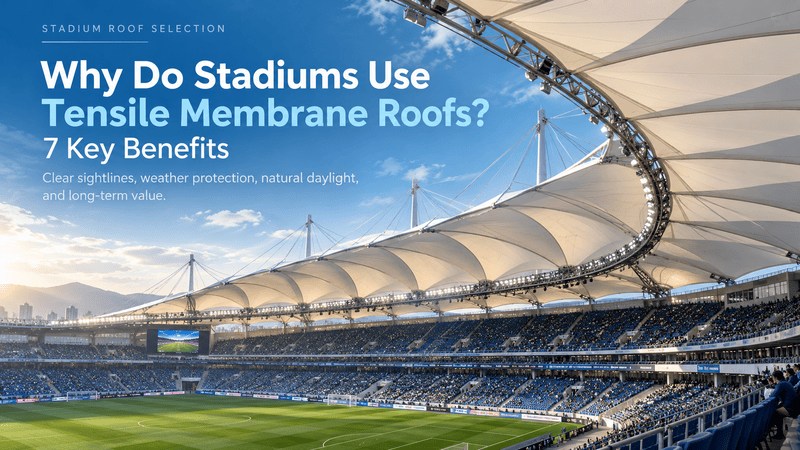
    Why Do Stadiums Use Tensile Membrane Roofs? 7 Key Benefits

    Stadiums use tensile membrane roofs because these systems can cover wide seating areas with fewer view-blocking supports while providing shade, rain protection, natural daylight, and distinctive roof designs. Their lightweight roof coverings can also create more flexibility for large stadium projects. A stadium roof must do more than look good. It needs to suit the seating layout, local climate, budget, and long-term maintenance plan. Here are seven practical benefits of tensile membrane stadium roofs—and what owners should consider before choosing one. 1. Large-Span Coverage With Clearer Stadium Sightlines Large stadiums need roofs that cover wide seating areas without placing columns in the way of the action. Tensile membrane roof systems can help achieve this by spanning large areas with a combination of prestressed membrane material, cables, and steel supports. With a well-designed support arrangement, structural elements can be positioned away from key viewing areas. Spectators enjoy a clearer view of the pitch, while architects gain more flexibility…

  • 12 Types of Tensile Structures: Membrane Shapes & Applications

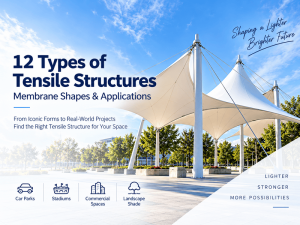
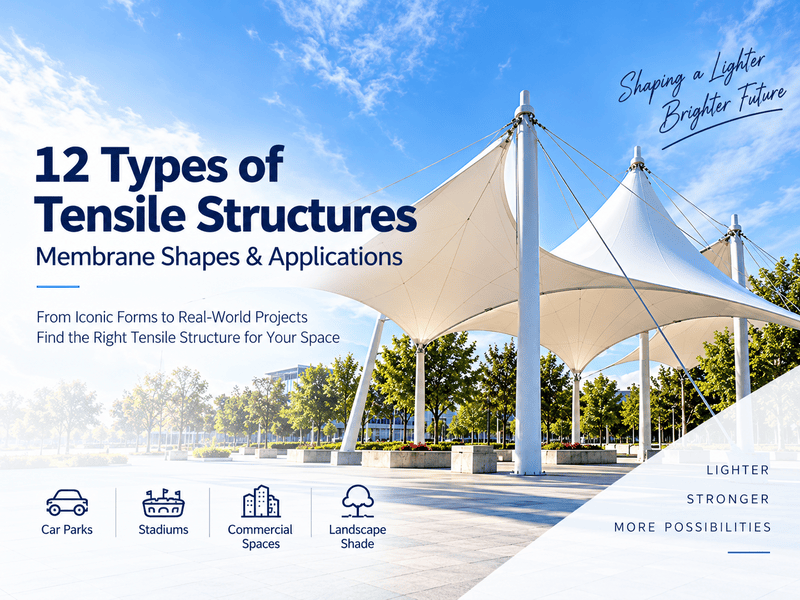
    12 Types of Tensile Structures: Membrane Shapes & Applications

    Tensile membrane structures can take many architectural forms by combining membrane curvature, high and low points, steel arches, masts, edge cables, and cable systems. Common configurations include hypar, conical, barrel vault, arch-supported, saddle-shaped, ridge-and-valley, wave-shaped, and umbrella structures. Each form behaves differently in terms of load transfer, coverage efficiency, drainage, visual character, and suitability for different sites. This guide introduces 12 common types of tensile structures and compares their membrane shapes, support systems, key advantages, and typical applications. It is intended to help owners, architects, consultants, and project procurement teams narrow down suitable concepts for car parks, stadiums, commercial plazas, landscape shade structures, and other architectural projects. For a broader overview of where these systems are used, see Yexing’s guide to tensile structure applications. 12 Common Types of Tensile Structures at a Glance Hypar Tensile Structure Conical Tensile Structure Barrel Vault Tensile Structure Arch-Supported Tensile Structure Saddle-Shaped Tensile Structure Ridge-and-Valley Tensile Structure Wave-Shaped Tensile Structure Umbrella Tensile…

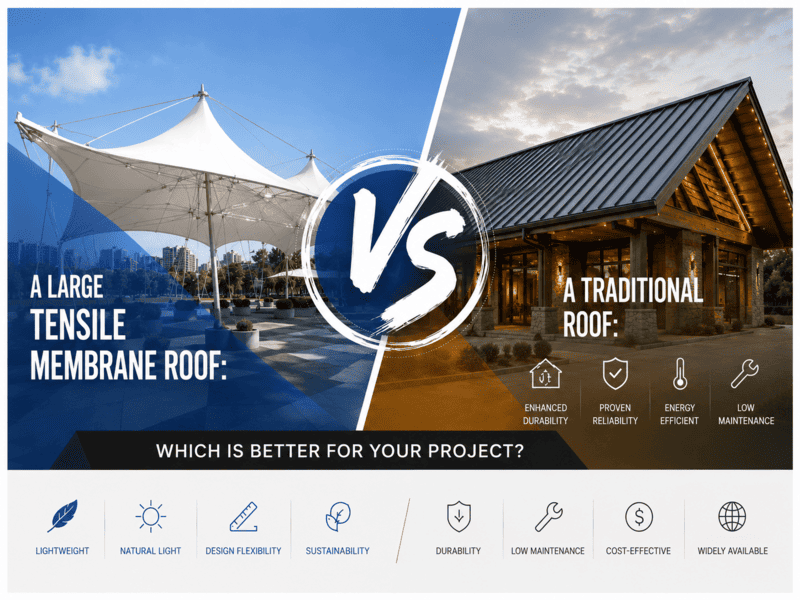
  • A Large Tensile Membrane Roof vs. a Traditional Roof: Which Is Better for Your Project?

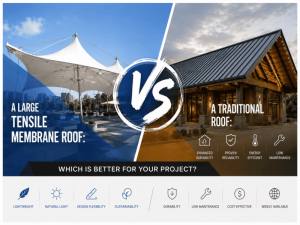
    A Large Tensile Membrane Roof vs. a Traditional Roof: Which Is Better for Your Project?

    Choosing between a tensile membrane roof and a traditional roof is not about finding one system that is better in every situation. It is about finding the roof that fits your project. A tensile membrane roof is often a better fit for large spans, lightweight structures, semi-open spaces, and projects where the roof is part of the architectural identity. A traditional roof is often a better fit for enclosed buildings that need strong thermal insulation, acoustic control, regular roof access, and standard construction details. The right choice depends on span, building use, structural load, climate, installation conditions, maintenance needs, and total project cost. This guide compares both systems from a project owner’s point of view. Tensile Membrane Roof vs. Traditional Roof: What Are the Main Differences? A traditional roof usually uses rigid structural members and conventional roof layers. Common examples include metal roofing, insulated sandwich panels, concrete roofs, and tiled roofs. A tensile membrane roof works differently….

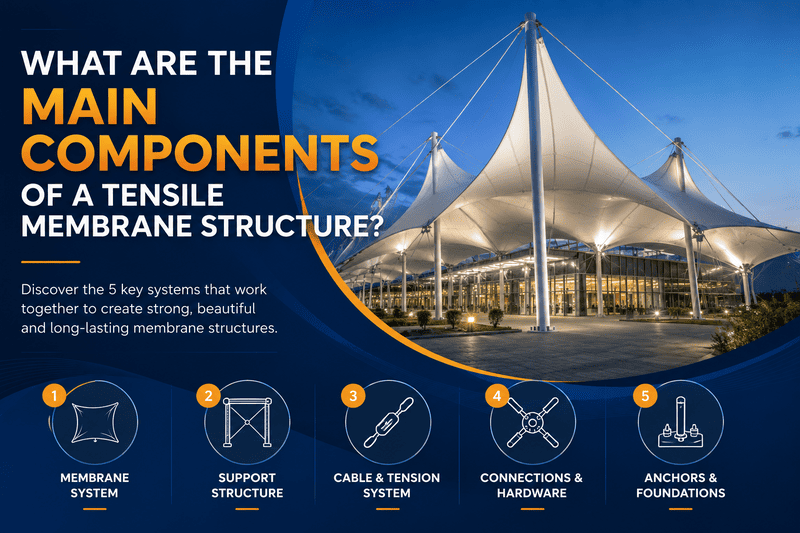
  • What Are the Main Components of a Tensile Membrane Structure?

    What Are the Main Components of a Tensile Membrane Structure?

    If you are evaluating a tensile membrane roof, stadium canopy, entrance structure, or large-scale shade system, one of the first questions to answer is not simply whether a particular membrane material is “good.” A more useful question is, “What components make up a complete tensile membrane structure, and how do they work together to transfer loads safely into the supporting structure and foundations?” From an engineering and procurement perspective, a typical tensile membrane structure can be divided into five main systems: the membrane system, supporting structure, cable and tensioning system, connection nodes and hardware, and anchorage and foundations. Drainage, waterproofing, corrosion protection, and maintenance provisions are not always classified as primary structural components, but they still have a major influence on long-term performance. The 5 Main Components of a Tensile Membrane Structure Main Component Primary Function Typical Materials or Parts What Should You Check? 1. Membrane System Forms the architectural surface and carries in-plane tensile forces under prestress…

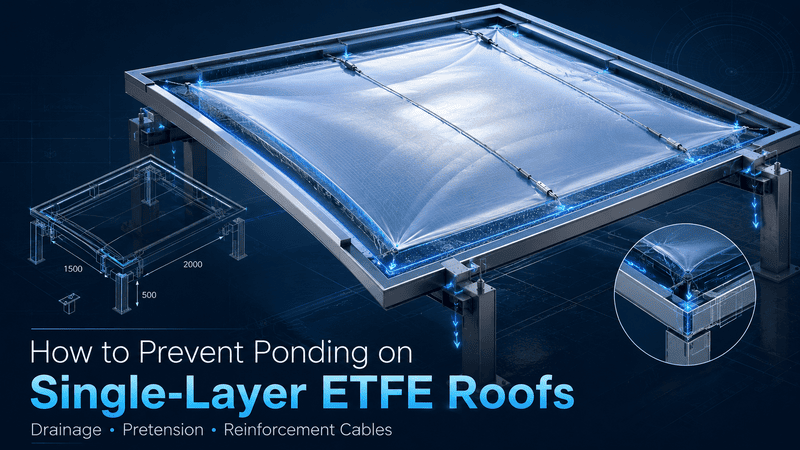
  • How to Prevent Ponding on Single-Layer ETFE Roofs

    How to Prevent Ponding on Single-Layer ETFE Roofs

    Single-layer ETFE roofs are lightweight, transparent, and well suited to long-span architecture, but their drainage behavior is different from that of rigid metal or glass roofs. On a shallow, nearly flat ETFE panel, the main risk is not simply that the nominal slope looks small. The critical problem is a local depression that develops under rain load: water collects, the membrane deflects further, and the deeper depression attracts more water. That feedback loop is the mechanism behind roof ponding. This guide uses the BIM model, detail drawings, measured dimensions, and on-site rectification records from a 1:1 ETFE mock-up for Qingdao Youth Football Stadium to answer a practical design-and-construction question: how can a project team reduce single-layer ETFE roof ponding risk before large-area installation begins? Scope and design boundary Every dimension and construction detail below comes from the Qingdao Youth Football Stadium ETFE mock-up. Other projects must be designed for their own local design rainfall intensity, span, support…

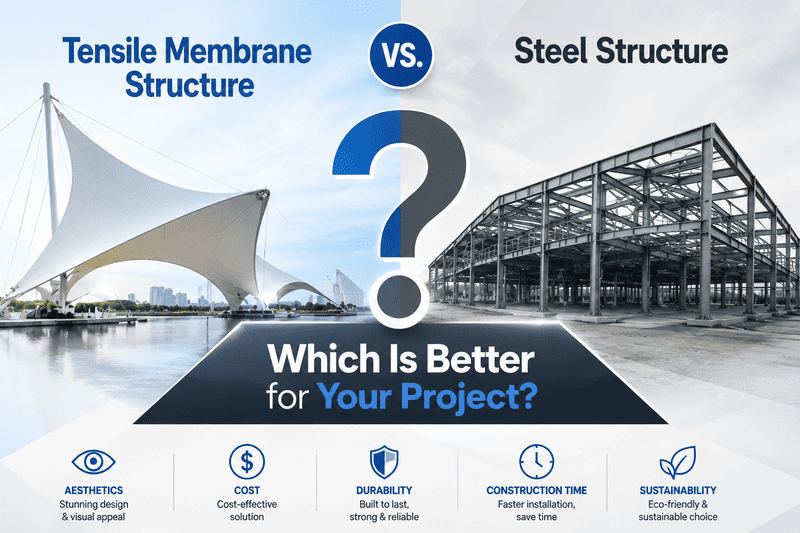
  • Tensile Membrane Structure vs. Steel Structure: Which Is Better for Your Project?

    Tensile Membrane Structure vs. Steel Structure: Which Is Better for Your Project?

    For long-span projects such as stadium grandstand roofs, commercial plazas, carports, transportation hubs, warehouses, and industrial buildings, a tensile membrane structure and a steel structure are often compared side by side. For you as a project owner, the real question is not which system is “better” in general. The better choice is the one that fits your project use, span, loads, budget, schedule, architectural goals, and long-term maintenance needs. The comparison below explains the main differences between tensile membrane structures and steel structures. It covers structural weight, long-span capability, load capacity, enclosure, design freedom, natural daylight, construction time, total project cost, durability, and maintenance. You will also find practical selection guidance for different project types. Tensile Membrane Structure vs. Steel Structure: Key Differences at a Glance Comparison Criteria Tensile Membrane Structure Conventional Steel Structure Best-Suited Functions Open or semi-open shade and rain-protection coverage Fully enclosed, industrial, warehouse, and heavy-load buildings Structural Self-Weight Lightweight roof system; often helps…

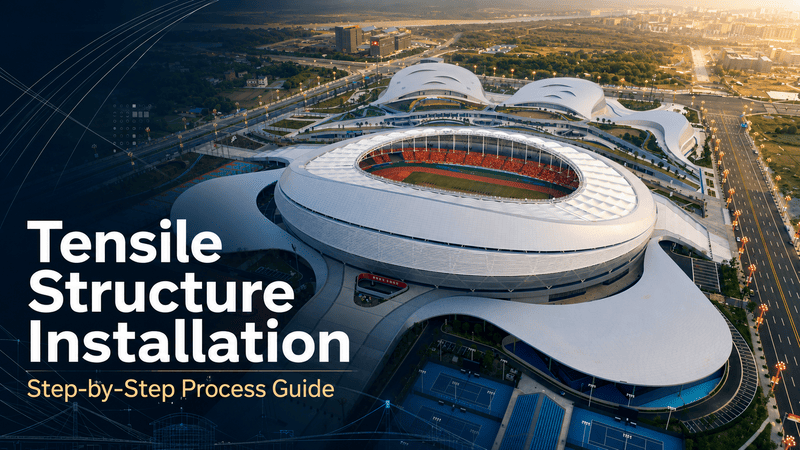
  • Tensile Structure Installation: Step-by-Step Process Guide

    Tensile Structure Installation: Step-by-Step Process Guide

    Tensile structure installation involves much more than placing a membrane over a steel frame and pulling it tight. A successful project requires the foundations, anchor points, steel supports, cable system, membrane panels, connection hardware, and drainage details to work together as one coordinated system. The installation process normally includes site verification, steel erection, membrane inspection, lifting and positioning, initial connection, progressive membrane tensioning, final inspection, and project handover. A problem at any stage can affect the final membrane geometry, pretension distribution, connection safety, and drainage performance. Incorrect anchor locations may prevent a membrane panel from reaching its fixing points. Incorrect panel orientation may result in removal and reinstallation. An unsuitable tensioning sequence may create wrinkles, uneven loading, localized overstress, or unintended low points where water can collect. This step-by-step guide explains the complete tensile structure installation process in the order it usually takes place on site. It is intended to help project owners, architects, contractors, and site…

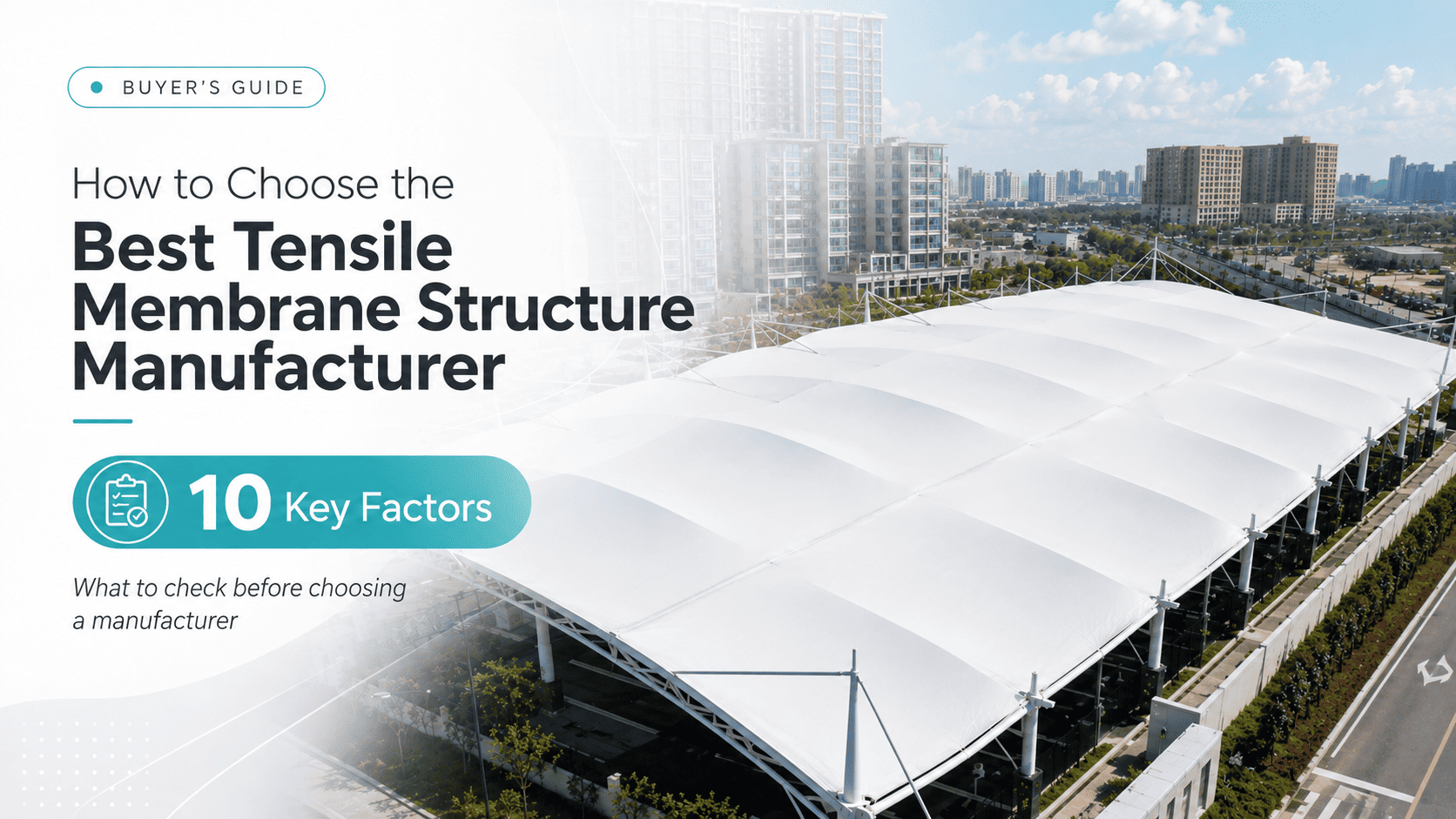
  • How to Choose the Best Tensile Membrane Structure Manufacturer: 10 Key Factors

    How to Choose the Best Tensile Membrane Structure Manufacturer: 10 Key Factors

    Choosing a tensile membrane structure manufacturer should involve more than comparing prices, factory size, or project renderings. A tensile membrane structure is a coordinated engineering system involving architectural form, form-finding analysis, structural calculations, membrane fabrication, steelwork, cable systems, connection details, foundation interfaces and on-site installation. Even when high-quality membrane material is specified, inadequate structural analysis, drainage design, fabrication accuracy or tensioning control can still result in wrinkles, ponding water, structural deformation, installation delays and higher maintenance costs. The best tensile membrane structure manufacturer is one that can respond to the actual project location and site conditions with reliable engineering, clearly specified materials, verifiable manufacturing quality and well-defined installation and warranty responsibilities. This guide explains 10 key factors that project owners, architects, contractors and procurement teams can use to compare tensile structure manufacturers and reduce design, approval, manufacturing, shipping and installation risks. Technical note: This guide applies to tensile membrane carports, commercial canopies, stadium roofs, transportation facilities, landscape…

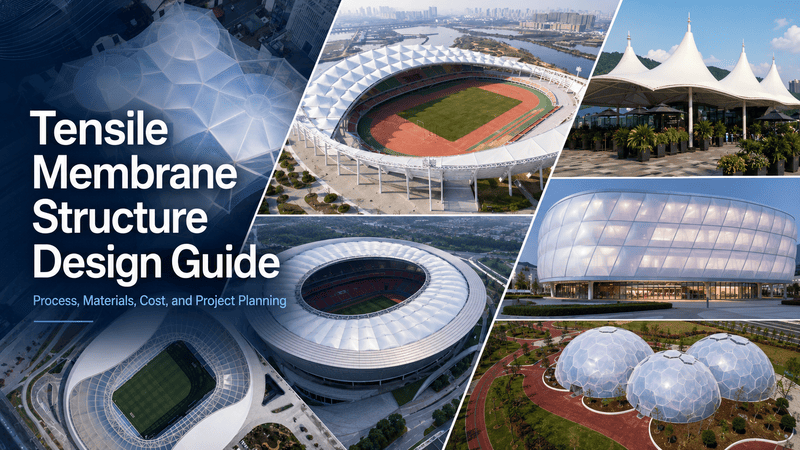
  • Tensile Membrane Structure Design Guide: Process, Materials, Cost, and Project Planning

    Tensile Membrane Structure Design Guide: Process, Materials, Cost, and Project Planning

    A tensile membrane structure is a lightweight spatial system in which the membrane, cables, supporting steelwork, connections, and initial prestress work together. These structures are widely used for car parks, entrance canopies, stadium stands, commercial plazas, transport facilities, and building atriums. Unlike a conventional rigid roof, the curved form of a tensile membrane is part of the load-bearing system. Changes to membrane curvature, prestress, support locations, or material properties can affect structural behavior, drainage, connection design, foundation reactions, installation methods, and overall project cost. For this reason, a buildable tensile structure cannot be developed by focusing only on appearance or comparing membrane prices alone. The membrane, cables, steel supports, connections, foundations, drainage, and site conditions must be evaluated as one coordinated system. What This Tensile Structure Guide Covers Common Project Question What You Will Learn How is a tensile membrane structure designed? The complete process, from project requirements and form-finding to fabrication, installation, and inspection. How do…

  • What Is ETFE Membrane? Properties, Applications, Structure Types and Design Guide

    What Is ETFE Membrane? Properties, Applications, Structure Types and Design Guide

    ETFE membrane — also called ETFE foil, ethylene tetrafluoroethylene film, or ETFE architectural membrane — is a high-performance fluoropolymer-based transparent building material used for lightweight roofs, façades, and skylight systems. Originally developed for the aerospace industry, ETFE membrane has become one of the most widely adopted material innovations in modern architecture, appearing everywhere from Olympic stadium roofs to airport terminal canopies and commercial atrium skylights. Walk through any major city’s new developments, and you’ve almost certainly stood under ETFE without knowing it. That impossibly light canopy at the airport? The bubble-like roof over the sports arena? The atrium that somehow feels open to the sky while keeping the rain out? That’s ETFE membrane. It’s not glass. It’s not plastic sheeting. And it’s definitely not what most people picture when they hear the words “architectural membrane.” This guide covers what ETFE membrane actually is, how the different ETFE structure types work, where ETFE makes sense (and where it…

  • What Is PTFE Tensile Membrane? Properties, Cost, Applications & Comparison Guide

    What Is PTFE Tensile Membrane? Properties, Cost, Applications & Comparison Guide

    If you’re planning a stadium, an airport terminal, a train station canopy, or a big commercial roof, someone has probably already mentioned “PTFE membrane” to you. Maybe you’ve seen photos of those crisp white tensile roofs and wondered if that’s what your project needs. Maybe a contractor sent you a quote, and the number made your eyes water. This guide is for you. No marketing fluff. No AI-generated filler about “unlocking the power of architectural fabrics.” Just the real answers to the questions people ask us after 18 years of designing, fabricating, and installing PTFE membrane structures across four continents. PTFE tensile membrane is a glass-fiber fabric coated with PTFE (the same fluoropolymer as Teflon). Installed correctly, it forms a lightweight, self-cleaning, fire-safe roof that lasts 25 to 35 years. It costs more upfront than PVC or PVDF membranes. Over 30 years, it’s usually the cheapest option. That’s the 30-second version. The rest of this page explains…

  • What Is PVDF Tensile Fabric? Properties, Structure, Advantages, and Applications

    What Is PVDF Tensile Fabric? Properties, Structure, Advantages, and Applications

    PVDF tensile fabric — also called PVDF membrane — is a high-performance architectural fabric composed of three bonded layers: a load-bearing polyester woven base, a waterproof PVC coating, and a polyvinylidene fluoride (PVDF) fluoropolymer topcoat that provides UV resistance, self-cleaning capability, and a 15 to 25-year service life. It is the most widely specified membrane material in tensile architecture worldwide, used in stadium roofs, airport canopies, commercial atriums, and public shade structures. But what separates a proper architectural-grade PVDF tensile fabric from a basic PVC tarp that looks terrible in three years? How do you choose between weldable and non-weldable grades, or between PVDF, PTFE, and ETFE? We’re a Shenzhen-based membrane structure engineering company with Special Grade qualifications in design, fabrication, and installation — the highest industry tier — and over three million square meters of completed tensile membrane projects since 2008. Here’s what we’ve learned about PVDF from working with it on real projects across China,…

  • PTFE vs PVDF vs ETFE: Which Tensile Membrane Material Is Best for Your Project?

    PTFE vs PVDF vs ETFE: Which Tensile Membrane Material Is Best for Your Project?

    Tensile membrane materials such as PTFE, PVDF, and ETFE are widely used in modern architectural engineering. Each offers distinct advantages in durability, transparency, cost, and structural performance, making them suitable for stadiums, airport terminals, commercial complexes, parking canopies, and other large-span structures. Choosing the right material depends on project requirements, budget, and design goals. This article provides a clear comparison of PTFE, PVDF, and ETFE membranes, helping architects and engineers make informed decisions.   What Are Tensile Membrane Materials? Tensile membrane materials are lightweight architectural fabrics or films designed to work under tension. They are widely used for long-span roof systems due to their: High strength-to-weight ratio Flexible architectural form Excellent daylight performance (especially ETFE) Efficient structural spanning capability PTFE vs PVDF vs ETFE Tensile Membrane Materials: Comparison Overview This table summarizes the key differences between PTFE, PVDF, and ETFE to help architects and engineers quickly select the most suitable tensile membrane material. Feature PTFE PVDF ETFE…

WhatsApp

+852 69447081

Message Email

yexing01@yexingms.com

Top

Leave us a Message

We usually reply within 24 hours.

Contact Form