Choosing a tensile membrane structure manufacturer should involve more than comparing prices, factory size, or project renderings.
A tensile membrane structure is a coordinated engineering system involving architectural form, form-finding analysis, structural calculations, membrane fabrication, steelwork, cable systems, connection details, foundation interfaces and on-site installation. Even when high-quality membrane material is specified, inadequate structural analysis, drainage design, fabrication accuracy or tensioning control can still result in wrinkles, ponding water, structural deformation, installation delays and higher maintenance costs.
The best tensile membrane structure manufacturer is one that can respond to the actual project location and site conditions with reliable engineering, clearly specified materials, verifiable manufacturing quality and well-defined installation and warranty responsibilities.
This guide explains 10 key factors that project owners, architects, contractors and procurement teams can use to compare tensile structure manufacturers and reduce design, approval, manufacturing, shipping and installation risks.
Technical note: This guide applies to tensile membrane carports, commercial canopies, stadium roofs, transportation facilities, landscape structures and projects using PVC/PVDF, PTFE or ETFE membrane systems. Final designs should always be checked against project-specific codes and loading conditions by appropriately qualified engineering professionals.
What Should You Check When Comparing Tensile Membrane Structure Manufacturers?
Before selecting a tensile membrane structure supplier, evaluate the following areas:
- Relevant project experience
- Design and engineering capability
- Compliance with local codes and loading requirements
- Clear and traceable material specifications
- Verifiable manufacturing and quality control
- Custom design and technical optimization capability
- Installation responsibilities and project management
- Certifications, warranties and after-sales responsibility
- Communication, document control and shipping management
- Total project value rather than quotation price alone
Before requesting a formal quotation, prepare the project location, preliminary dimensions, architectural drawings, intended use, column restrictions, target schedule and required installation scope. The more complete the project information, the more accurate and comparable the proposed solutions and prices will be.
1. Does the Manufacturer Have Relevant Tensile Structure Project Experience?
A company’s age does not necessarily prove that it is suitable for your project. What matters more is whether the manufacturer has completed tensile membrane structures with a similar function, span, structural form, membrane type and environmental exposure.
For example, a small tensile carport and a large stadium roof may both use membrane materials. Still, their form-finding analysis, steel member sizes, connection forces, lifting equipment and project management requirements are fundamentally different.
What Project Experience Should You Check?
Look for completed projects with:
- The same or a similar building use
- A comparable covered area and maximum span
- A similar tensile membrane structural form
- Similar PVC/PVDF, PTFE or ETFE materials
- Comparable wind, snow, rainfall or coastal corrosion conditions
- Similar site access and installation constraints
- Experience in the same country or a region with comparable regulations
Do not rely only on renderings or heavily edited marketing images. Confirm what the manufacturer actually delivered on each project, such as:
- Architectural or structural design
- Structural analysis
- Membrane fabrication
- Steel structure fabrication
- Material supply
- Installation supervision
- Full on-site installation
- Overall project coordination
Questions to Ask the Manufacturer
Can you provide three completed projects that are similar to ours in use, span, structural form and climate conditions, and explain your exact scope of work on each project?
Warning Signs
- Only renderings are available, with no completed-project photographs
- The project name, location, or basic dimensions cannot be verified
- The manufacturer cannot explain its actual role
- The references are substantially different from your project
- The projects shown were not completed by the company making the claim
2. Does the Manufacturer Have Reliable Tensile Membrane Design and Engineering Capability?
The stability of a tensile membrane structure depends on the coordinated behaviour of its three-dimensional curvature, membrane prestress, cable system, supporting steelwork and anchorage system.
A manufacturer should therefore not quote only based on covered area or reuse a structural arrangement from another project without analysis. Each project must be assessed according to its site conditions, intended use, structural span and design loads.
What Does Professional Tensile Membrane Structure Design Include?
A complete engineering process may include:
- Site conditions and functional requirements analysis
- Architectural form and structural system evaluation
- Membrane form-finding analysis
- Membrane stress analysis
- Wind, snow, and rainfall load analysis
- Steel structure and cable calculations
- Connection and anchorage design
- Membrane patterning analysis
- Foundation reaction calculations
- Fabrication drawing development
- Installation drawing development
How Can You Assess the Manufacturer’s Engineering Capability?
Confirm that the manufacturer has a clearly identified engineering team and that responsibility for the structural calculations and final design is defined.
You should also determine:
- Whether the design is completed in-house or outsourced
- Whether the responsible engineers have comparable project experience
- The exact scope of any external engineering consultant
- Who checks and approves structural calculations
- Who coordinates design revisions
- How design, fabrication and installation teams exchange information
- Whether the technical documents can be submitted to the client’s engineer or local approval authority
Technical Documents to Request
Depending on the agreed scope, request the following:
- Design criteria or basis-of-design document
- Structural calculation report
- Form-finding and membrane stress analysis
- Steel structure calculations
- Cable system calculations
- Detailed connection drawings
- Foundation reaction data
- General arrangement drawings
- Fabrication drawings
- Installation drawings
Questions to Ask the Manufacturer
Can you complete the structural analysis using the codes and loading conditions applicable to the project location, and provide technical documents suitable for review by our engineer or the local approval authority?
Warning Signs
- The manufacturer shows software screenshots but cannot explain the input conditions or calculation logic.
- No one is clearly responsible for the structural design
- A final structural solution is proposed before the project location, and loads are confirmed
- Foundation reactions cannot be provided
- Connection details are unavailable
- Design, fabrication, and installation teams have no clear technical coordination process.
- Design revisions do not follow a documented review and approval procedure. e
3. Does the Design Comply With Local Codes and Project-Specific Loads?
A tensile membrane structure must be engineered for its actual construction location.
Basic wind speed, snow load, rainfall intensity, temperature range, seismic requirements, and approval procedures can vary significantly between countries, regions, and cities. A design developed for one location should not be transferred to another without recalculation.
What Loads May Need to Be Considered?
Depending on the project, the structural design may need to account for:
- Dead loads
- Live loads
- Wind pressure and wind suction
- Snow loads
- Rainwater and ponding loads
- Seismic actions
- Temperature effects
- Lighting, screens and other suspended equipment
- Erection and installation loads
- Inspection and maintenance loads
What Design Parameters Should the Manufacturer Confirm?
Do not accept a vague statement such as “designed to international standards”. Ask the tensile membrane manufacturer to state:
- The specific building or structural design code
- The edition or version of that code
- The basic wind speed used
- The wind height, terrain category, and return period
- Whether snow loading applies and what value is used
- Whether seismic design is required
- The governing load combinations
- Whether temperature and equipment loads are included
- Whether a locally licensed engineer must review or seal the design
- Who will coordinate with local engineers and approval authorities
Why Is Drainage Design Critical for Tensile Membrane Structures?
Membrane drainage involves more than adding one or two outlets. The designer must use the membrane’s three-dimensional curvature, high and low points, and prestress to direct water toward the intended drainage areas.
The design must also consider how the membrane deforms under wind and rain loads. An apparently adequate drainage path in the unloaded geometry may not remain adequate after deformation.
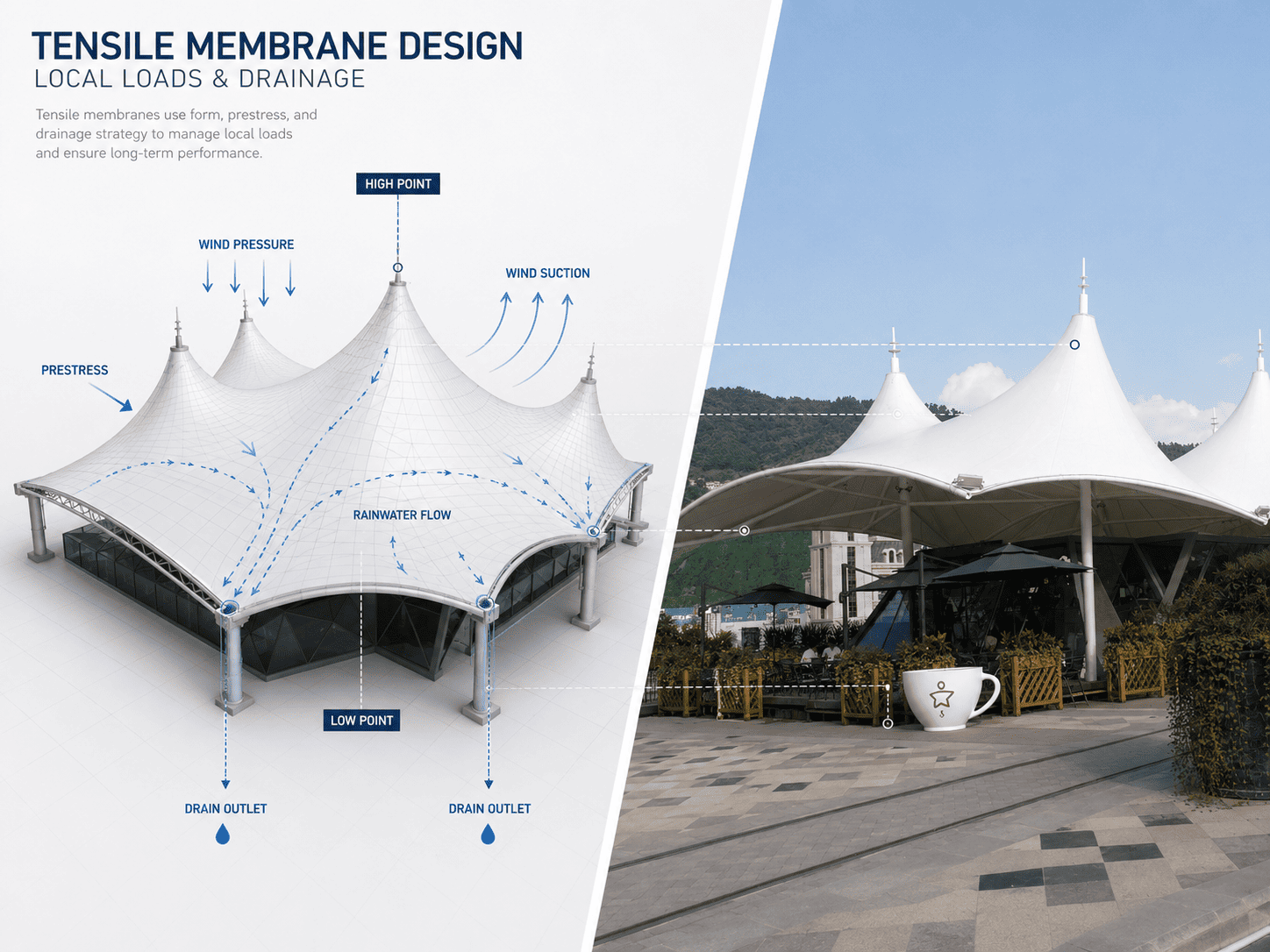
The drainage proposal should identify:
- Membrane high points and low points
- Water flow directions
- Gutter, downpipe or outlet locations
- Final discharge locations
- The design capacity of the drainage system
- Measures used to prevent local ponding
Questions to Ask the Manufacturer
Which design codes will be used for this project, and what wind speed, snow load, rainfall criteria, load combinations and drainage parameters will be applied?
Warning Signs
- The supplier only says the design “meets international standards”
- Final design begins before the project address is confirmed
- Load values, design assumptions and load combinations are not disclosed
- Membrane deformation is not considered in the drainage analysis
- The drainage plan shows outlets but no high points, low points or water flow paths
- Local engineering review, stamping or approval responsibilities are unclear
4. Are the Membrane, Steelwork, Cables and Connections Clearly Specified and Traceable?
Two tensile membrane structure quotations can have similar totals while using substantially different materials.
Descriptions such as “premium membrane”, “high-quality steel” or “imported accessories” are not sufficient technical specifications. The quotation, technical agreement and drawings should identify the manufacturer, product model, material grade, dimensions and key performance properties.
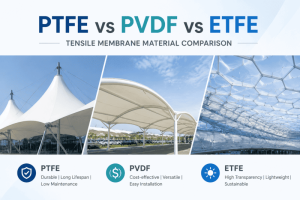
What Is the Difference Between PVC/PVDF, PTFE and ETFE Membrane Materials?
PVC and PVDF Membranes
PVC-coated polyester fabric is widely used for tensile carports, commercial canopies, entrance structures and general shade applications.
PVDF is commonly used as a surface treatment on PVC-coated fabric to improve cleanability and resistance to surface contamination. Different PVC/PVDF products can vary considerably in base-fabric strength, coating formulation, topcoat, fire performance, weather resistance and suitable exposure conditions.
PTFE Membranes
A PTFE-coated fibreglass membrane is commonly selected for permanent projects requiring long-term weather resistance, strong fire performance and a high-quality architectural appearance.
PTFE membrane projects generally require tighter control over patterning, seam fabrication, folding, packing, transportation and installation.
ETFE Systems
ETFE film can be used in single-layer structures or pneumatic cushion systems. It is suitable for projects requiring high light transmission, low structural weight, or a transparent architectural appearance.
There is no single “best membrane material” for every project. Selection should consider:
- Required design life
- Light transmission
- Fire performance
- Local climate
- Pollution and corrosion exposure
- Cleaning and maintenance requirements
- Architectural appearance
- Project budget
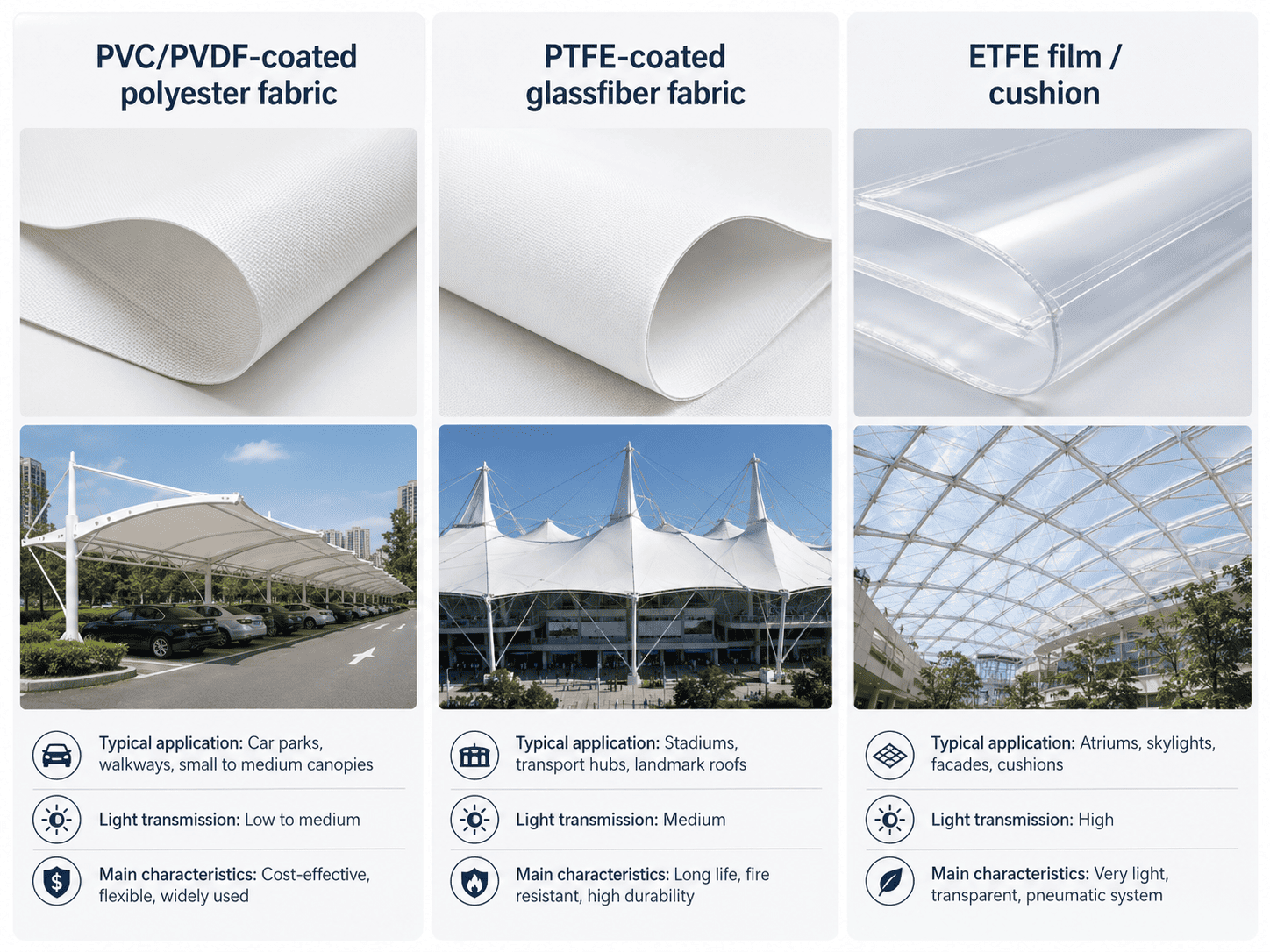
What Membrane Information Should Be Confirmed?
The specification should identify:
- Membrane material manufacturer
- Brand and product model
- Base fabric or film type
- Weight per unit area or film thickness
- Tensile strength
- Tear strength
- Coating system
- Surface treatment
- Fire classification
- Light transmission
- Recommended exposure conditions
- Product warranty
- Technical data sheet
- Test reports
- Batch traceability information
What Steel Structure Information Should Be Confirmed?
The steelwork specification should state:
- Steel grade
- Member section sizes
- Tube wall thicknesses
- Plate thicknesses
- Welding class and technical requirements
- Bolt grades
- Galvanizing or coating system
- Surface preparation standard
- Coating or galvanizing thickness
- Suitability for the corrosion environment
- Steel mill certificates or material certificates
Why Should Cables and Small Connection Components Not Be Overlooked?
Edge cables, cable end fittings, clamping plates, turnbuckles, fasteners, and anchor connections may be small, but they transfer critical structural forces.
Confirm that all cables and connection components:
- Are included in the structural calculations
- Have clearly defined material and strength grades
- Are fully included in the quotation
- Are numbered on design and installation drawings
- Are listed separately on the packing list
- Can be traced to their material or production batch
Question to Ask the Manufacturer
Can the membrane, steelwork, cables and connection components in your quotation be identified by brand, model, grade, dimensions and key technical properties, with the relevant data sheets and test documents?
Warning Signs
- Materials are described only as “premium”, “high strength” or “imported”
- The quotation, technical agreement and data sheets are inconsistent
- Product models, material certificates or test reports cannot be provided
- Cables and connections are not listed in the quotation or drawings
- Delivered materials cannot be matched to approved documents or samples
- Material origin and batch records are unavailable
5. Can the Manufacturing and Quality Control Process Be Verified?
A reliable design can only be realised through controlled fabrication, inspection and quality management.
Factory exterior photographs and promotional videos do not prove that a supplier has the equipment, trained personnel or quality procedures required to fabricate tensile membranes and structural steelwork.
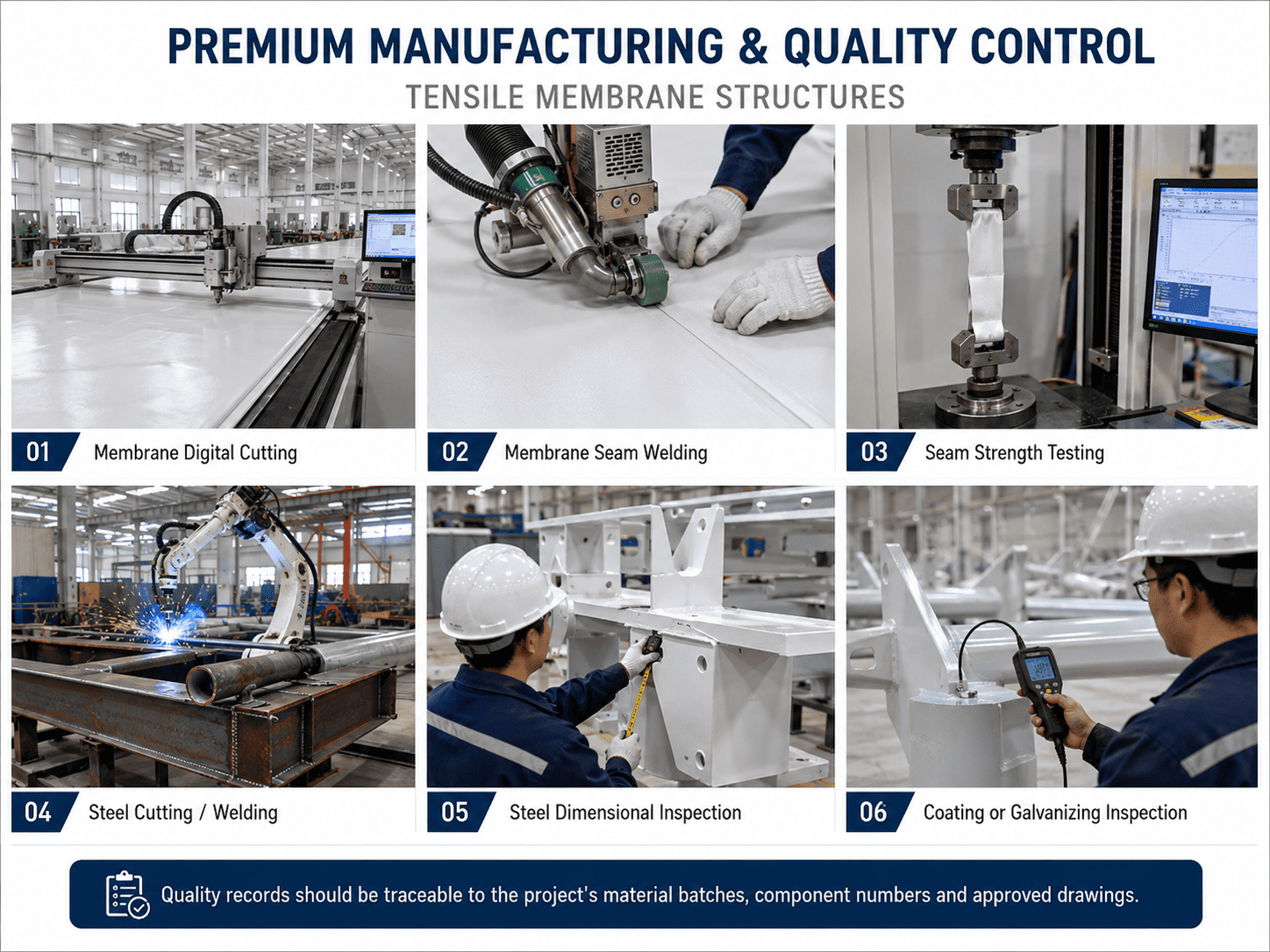
What Should Be Checked in Membrane Fabrication?
Review the manufacturer’s procedures for:
- Incoming material inspection
- Roll identification and batch traceability
- Digital pattern cutting
- Membrane panel positioning accuracy
- Welding or seaming equipment condition
- Process parameter control
- Seam strength testing
- Edge reinforcement
- Corner detailing
- Finished panel dimension checks
- Cleaning, packing and transport protection
Errors in pattern cutting, positioning or seam fabrication can cause wrinkles, uneven prestress, misaligned seams or distortion of the intended membrane geometry.
The manufacturer should be able to provide not only equipment photographs, but also controlled process parameters, seam test results and dimensional inspection records.
What Should Be Checked in Steel Fabrication?
Review:
- Raw material certificates
- Member layout and marking
- Cutting and drilling accuracy
- Welding procedure qualification
- Welder qualifications
- Visual weld inspection
- Required nondestructive testing
- Member dimensional inspection
- Trial assembly where necessary
- Blasting or surface preparation
- Coating or galvanizing inspection
- Member identification
- Packing and transport protection
For complex structures or projects with tight installation tolerances, factory trial assembly can identify hole misalignment, member interference, and connection fit-up problems before shipment.
What Quality Documents Should Be Requested?
Depending on the project, request the following:
- Project quality control plan
- Incoming material inspection records
- Material certificates
- Welding inspection records
- Nondestructive testing reports
- Member dimensional inspection sheets
- Membrane seam test reports
- Coating or galvanizing inspection reports
- Pre-shipment inspection records
- Packing list
- Packing photographs
- Nonconformance and corrective-action records
Quality records should correspond to the actual project material batches, member numbers, drawing revisions, and shipment documents. Generic samples do not prove that the same controls were applied to your order.
For high-value, complex or long-distance international projects, consider:
- An on-site factory audit
- A live video factory inspection
- Production-stage witness inspections
- Independent third-party inspection
- Pre-shipment inspection
Independent inspection does not replace the manufacturer’s own quality control, but it can help verify production capability, material consistency, and shipment completeness.
Questions to Ask the Manufacturer
What quality inspections are carried out when materials arrive, during fabrication and before shipment? Can you provide records linked to our project’s material batches and component numbers?
Warning Signs
- The manufacturer will not show the actual production area
- No project-specific quality control plan is available
- The factory lacks relevant processing or inspection equipment
- Similar projects in production or completed fabrication records cannot be shown
- Inspection records cannot be linked to your materials or component numbers
- Production, inspection, packing and shipment records do not form a traceable chain
- Only generic certificates or sample inspection forms are provided
6. Does the Manufacturer Offer Genuine Custom Design and Technical Optimisation?
Tensile membrane structures are rarely standard off-the-shelf products.
Two projects may look similar but require completely different structural solutions because of column restrictions, structural spans, wind loads, drainage conditions, foundation locations, or installation access.
A capable tensile structure manufacturer should not copy an existing design or finalise a price before understanding the project constraints.
What Information Should the Manufacturer Request Before Quoting?
A responsible supplier should ask for the following:
- Project location
- Site dimensions
- Architectural or survey drawings
- Intended use
- Required clear height
- Permitted column locations
- Foundation conditions
- Preferred architectural form
- Drainage restrictions
- Lighting and equipment requirements
- Target schedule
- Budget range
- Required installation scope
- Local approval requirements
If a manufacturer provides a “final price” without understanding these conditions, the quotation is likely based on undisclosed assumptions. Later changes may increase steel weight, material quantities, engineering fees, or installation costs.
What technical optimisations can a capable manufacturer provide?
A competent tensile membrane structure manufacturer may be able to
- Adjust column positions to improve force distribution
- Optimize membrane curvature and drainage paths
- Simplify complex connections
- Reduce site welding
- Improve membrane pattern utilization
- Optimize steel structure weight
- Improve access for membrane deployment and tensioning
- Divide members according to container dimensions
- Reduce lifting operations
- Shorten installation time
- Reduce future inspection and maintenance difficulty
True customisation means more than fabricating exactly what appears on the client’s drawings. It means identifying structural, drainage, fabrication, and installation risks and proposing technically justified improvements.
Question to Ask the Manufacturer
If additional columns are not permitted, or if foundation locations are restricted, how would you modify the structural solution?
A professional response should explain:
- The effect on structural behavior and stability
- The effect on steel member sizes and total weight
- The effect on membrane curvature, prestress and drainage
- Feasible alternative structural systems
- Cost, fabrication and installation differences between alternatives
- Additional information required from the client
Warning Signs
- Any span or architectural form is promised without calculations
- The same structural solution is used for every project
- The manufacturer does not ask about the site, loads or foundations
- The company can only fabricate drawings and cannot offer engineering input
- The proposed optimisation has no calculation or technical basis
- The supplier cannot explain how design changes affect cost, drainage or installation
7. Are Installation Responsibilities and Project Management Boundaries Clear?
Many tensile membrane structure problems are not caused by the membrane material itself. They arise from foundation deviations, incorrect installation sequences, poor membrane handling, connection errors or improper tensioning.
Before placing an order, define the installation model, the manufacturer’s responsibilities and the level of technical support. These obligations should appear in the quotation, technical agreement or formal contract.
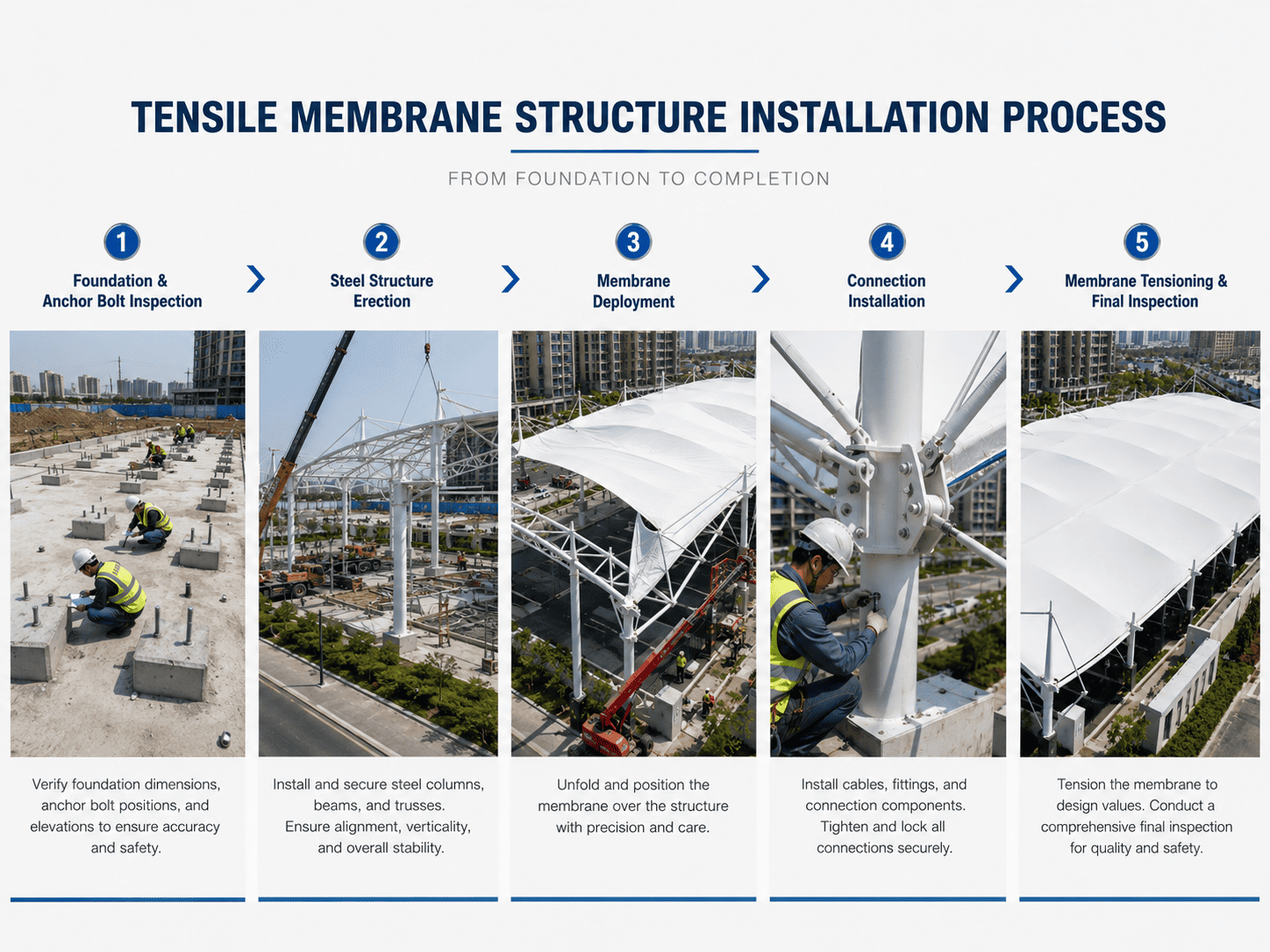
Common Tensile Structure Installation Models
Typical arrangements include the following:
- The manufacturer provides full installation
- The manufacturer sends technicians for on-site supervision
- A local contractor installs the structure using the manufacturer’s documents
- The manufacturer provides remote technical support
- The manufacturer supplies materials only
These options have different costs and risk allocations. Confirm whether the proposal includes full installation, supervision only, or drawings and remote guidance.
Which Installation Responsibilities Must Be Defined?
Regardless of the installation model, confirm:
- Who checks the foundations and embedded anchor bolts
- Who verifies foundation dimensions and tolerances
- Who prepares and approves the installation method statement
- Who provides cranes, aerial platforms and temporary supports
- Who installs the steel structure
- Who stores, handles and deploys the membrane
- Who tensions the membrane
- Who controls the tensioning sequence and final tension
- Who is authorized to approve site modifications
- Who performs final inspection and acceptance
- Who is responsible for damage during installation
The procedure for handling dimensional differences between the site and approved drawings is particularly important. Contractors should not cut members, weld additional components, or modify connections without engineering approval.
Which Installation Documents Should Be Provided?
Request:
- Anchor bolt layout
- Foundation interface requirements
- Foundation and anchor bolt tolerances
- Steel erection sequence
- Lifting plan and lifting-point requirements
- Temporary support requirements
- Membrane storage and deployment procedure
- Membrane tensioning sequence
- Connection installation requirements
- Connection inspection checklist
- Final acceptance criteria
- Maintenance and retensioning requirements
Installation documents should match the approved design drawings, component numbers, and packing list.
How Can You Assess Project Management Capability?
The manufacturer should appoint a clearly identified project manager to coordinate:
- Design and technical confirmation
- Drawing submission and approval
- Material procurement
- Production
- Quality inspection
- Packing and transportation
- Site installation
- Technical changes
- Final acceptance
The supplier should also provide a milestone-based schedule covering design approval, material procurement, fabrication, inspection, shipment and installation—not merely a final delivery date.
Question to Ask the Manufacturer
Who will coordinate the project from design approval through installation? If site dimensions, foundation locations or anchor bolts differ from the drawings, how will the change be raised, reviewed, approved and recorded?
Warning Signs
- Design, manufacturing and installation are handled separately with no overall project manager.
- No complete installation procedure or tensioning sequence is available
- The supplier cannot explain how site modifications are approved
- Installation responsibilities are agreed only verbally
- Responsibility for foundations, lifting equipment or installation damage is unclear
- Only a final delivery date is provided, with no milestone schedule
- Installation drawings, component numbers and packing lists do not match
8. Are Certifications, Warranties and After-Sales Responsibilities Genuine and Clearly Defined?
A large number of certificates does not automatically make a tensile membrane manufacturer reliable.
What matters is whether the documents are valid, whether the company named on them matches the contractual party, and whether their scope is relevant to the current project.
Buyers should also distinguish between membrane material warranties, fabrication warranties, installation warranties, and overall project responsibility.
Which Certifications and Documents Should Be Checked?
Depending on the project, relevant documents may include the following:
- Quality management system certification
- Environmental or occupational health and safety certification
- Welding procedure qualifications
- Welder qualification certificates
- Steel fabrication qualifications
- Membrane technical data sheets
- Membrane performance test reports
- Fire performance reports
- Steel material certificates
- Coating or galvanizing inspection reports
- Installer qualifications
- Project safety management documents
When reviewing these documents, check the following:
- Whether the company name is consistent
- Whether the certificate is still valid
- Whether the certification scope covers membrane structures, steel fabrication or installation
- Whether the product model in the test report matches the quotation
- Whether the test standard and method are applicable
- Whether the testing body is appropriately accredited
What Types of Warranty May Apply to a Tensile Membrane Structure?
A project may involve separate warranties for:
- Raw membrane material
- Membrane fabrication
- Membrane seams
- Structural steelwork
- Coating or galvanizing
- Cables and connection components
- Installation workmanship
A raw material warranty is not the same as a complete project warranty. It may not include inspection, removal, labour, equipment, transportation or reinstallation.
The contract should therefore state:
- The duration of each warranty
- The warranty commencement date
- The defects or failures covered
- Specific exclusions
- The client’s inspection and maintenance obligations
- The warranty claim and response procedure
- How responsibility will be investigated and determined
- Who pays for repair, replacement, labor, shipping and reinstallation
Questions to Ask the Manufacturer
If there is a problem with the membrane, seams, steelwork, connection components or installation, who is responsible for each item? Does the warranty include inspection, removal, labor, transportation and reinstallation?
Warning Signs
- The manufacturer promises a “long warranty” without written terms
- A raw membrane warranty is presented as a complete project warranty
- Exclusions and maintenance requirements are not explained
- The contractual party, production company and certificate holder are different
- Test reports do not match the materials in the quotation
- The manufacturer cannot explain its repair or claims procedure
- After-sales commitments are verbal and are not included in the contract
9. Are Communication, Document Control and International Delivery Reliable?
A manufacturer’s communication during the quotation stage often indicates how it will manage the project after the order is placed.
A professional tensile membrane structure manufacturer will not focus only on price, payment and delivery dates. It will also confirm the project location, design codes, wind and snow conditions, drawing status, installation scope, foundation responsibilities, transportation requirements and technical risks.
What Does Good Supplier Communication Look Like?
A reliable supplier will usually:
- Ask necessary technical questions
- Explain quotation assumptions
- Clearly identify included and excluded work
- Record important decisions in writing
- Maintain current drawing and document revisions
- Provide a realistic milestone schedule
- Highlight design, manufacturing, transportation and site risks
- Confirm the cost and schedule effects of design changes in writing
If a supplier asks very few questions about the project but repeatedly focuses on payment, its engineering coordination and project management capability should be examined more carefully.
What Should Be Checked in Drawing and Document Control?
Every formal drawing should include:
- Project name
- Drawing title
- Drawing number
- Revision number
- Issue date
- Approval status
- Units of measurement
- Applicable codes
- Necessary technical notes
The document control system should also ensure that:
- The client, design, production and installation teams use the same drawing revision
- Superseded revisions are withdrawn
- Design changes are fully recorded
- Drawings are reviewed and approved before production
- Shipping documents, packing lists and installation drawings match the final approved design
Effective revision control helps prevent outdated drawings from entering production or installation and reduces rework, material waste and site disputes.
What Should Be Checked for International Tensile Structure Shipments?
For export projects, confirm:
- Steel components have clear and durable identification numbers
- Component numbers match the installation drawings
- Membranes are protected against moisture, pressure and contamination
- Painted or galvanized steelwork is protected against impact damage
- Connection hardware is packed by node or installation area
- Small, easily lost components are separately identified
- Packaging is suitable for lifting, container loading and long-distance transport
- The packing list matches the drawings and physical shipment
- Commercial invoices, packing lists, certificates of origin and required shipping documents will be provided
- Incoterms, transfer of risk and responsibility boundaries are clearly stated
Poor component identification, mixed hardware or discrepancies between packing lists and installation drawings can lead to site delays, missing parts and installation errors.
Question to Ask the Manufacturer
Which documents will you provide during design, production, inspection and shipment? How will steel members, cables, connections and hardware be matched to the installation drawings and packing list?
Warning Signs
- Important technical decisions are confirmed only verbally or in informal chat messages.
- Drawings do not show revision numbers, issue dates or approval status
- The manufacturer cannot confirm which drawings are being used for production
- Design changes are not formally recorded or approved
- Components and hardware have no clear identification
- Packing lists, physical goods and installation drawings do not match
- Packaging is unsuitable for long-distance transport or site unloading
- Shipping terms and transfer-of-risk responsibilities are unclear
10. Compare Total Project Value, Not Only the Quotation Price
The lowest quotation does not necessarily produce the lowest project cost.
Some proposals appear less expensive because they exclude structural engineering, foundation coordination, cables, connection hardware, export packaging, transportation, installation supervision, inspections or warranty obligations.
Before comparing tensile membrane structure quotations, bring them to the same scope of work, material standard and responsibility boundary.
Tensile Membrane Structure Quotation Comparison Checklist
| Item | What to Confirm |
|---|---|
| Concept design | Number of concepts and permitted revision rounds |
| Structural design | Whether calculations, drawings and foundation reactions are included |
| Membrane material | Brand, product model, specification, area and reasonable waste allowance |
| Steel structure | Steel grade, member sizes, wall thicknesses and surface treatment |
| Cables and hardware | Whether all cables, connections, anchors and tensioning components are included |
| Foundations | Who designs the foundations, supplies anchor bolts and completes site construction |
| Factory inspection | Whether in-process and pre-shipment inspections are included |
| Third-party inspection | Whether independent inspection or witness fees are included |
| Packaging | Whether packaging is suitable for export, lifting, container loading and long-distance transport |
| Transportation | Incoterms, mode of transport, included costs and transfer of risk |
| Installation | Whether labor, equipment, travel, on-site supervision or remote support are included |
| Technical documents | Whether calculations, drawings, installation manuals and maintenance manuals are included |
| Warranty | Coverage, period, exclusions and responsible party |
| Taxes and duties | Whether taxes, customs duties, port charges and local costs are included |
| Project management | Whether design coordination, scheduling and change management are included |
Quotations are only directly comparable when their technical standards, material configurations and service scopes are substantially aligned.
What Hidden Costs Commonly Occur in Tensile Membrane Structure Projects?
Possible additional costs include:
- Local licensed engineer review fees
- Code review, engineering stamping or approval fees
- Foundation design and construction
- Embedded anchor bolts
- Design revisions and drawing changes
- Cranes and aerial work platforms
- Travel expenses for installation supervisors
- International and local transportation
- Customs duties, port charges and customs clearance
- Site coating repairs
- Replacement of damaged or missing components
- Future membrane retensioning
- Routine cleaning and maintenance
- Delays caused by drawing, material or delivery problems
Require the manufacturer to list all exclusions, optional items and potential additional charges in the formal quotation.
How Should Total Project Value Be Evaluated?
In addition to the initial purchase price, assess:
- Design and approval risk
- Material and fabrication quality
- Shipping and installation complexity
- Schedule reliability
- Risk of site rework
- Long-term maintenance costs
- The supplier’s ability to accept responsibility when problems occur
A competitive tensile membrane structure quotation should control the total project cost through reliable design, clear material specifications, complete delivery and defined responsibility—not simply through a low initial price.
Questions to Ask the Manufacturer
What is specifically excluded from this quotation? From concept design through manufacturing, shipping, installation and final acceptance, what additional costs could the client be required to pay?
Warning Signs
- The quotation is substantially lower than others, but the supplier cannot explain why
- Included and excluded work is not clearly defined
- Material specifications, quantities or waste allowances are not stated
- Design, connection hardware, packaging or installation support will be charged later
- Shipping terms, taxes and responsibility boundaries are unclear
- The supplier provides only a total price with no technical breakdown
- Potential additional charges will not be confirmed in writing
Quick Comparison Table for Tensile Membrane Structure Manufacturers
| Evaluation Factor | What to Check | Main Warning Signs |
| Project experience | Similar use, span, structural form and environment | Only renderings are shown, or projects cannot be verified |
| Engineering capability | Structural calculations, design drawings and responsible engineer | Complete calculations cannot be provided |
| Code compliance | Local codes, wind and snow loads, and drainage criteria | The supplier only claims compliance with “international standards” |
| Material specification | Brand, model, grade and performance data | Materials are described using vague marketing terms |
| Manufacturing quality | Equipment, inspection procedures and traceable quality records | The supplier will not show production or inspection processes |
| Custom design | Ability to address column, foundation and drainage constraints | The same solution is applied to every project |
| Installation support | Responsibility, installation procedure and acceptance criteria | Installation scope and responsibilities are unclear |
| Warranty and after-sales | Coverage, duration and claim procedure | Warranty commitments are only verbal |
| Communication and delivery | Drawing revisions, component numbers and export packaging | Documents are disorganised, and goods cannot be matched to drawings |
| Total project cost | Complete work scope and possible additional costs | The initial price is low, but many essential items are excluded |
Eight Warning Signs When Choosing a Tensile Membrane Structure Manufacturer
1. A Final Price Is Offered Before Basic Project Information Is Collected
If the manufacturer has not confirmed the project location, dimensions, design loads, span, and installation scope, its quotation is probably based on undisclosed assumptions. This increases the risk of later design changes and additional charges.
2. Structural Design Responsibility Is Unclear
The supplier cannot explain whether calculations are completed by an in-house engineer, an external consultant or another company. If approval, fabrication or site problems occur, responsibility may be disputed.
3. Material Descriptions Are Vague
The quotation uses terms such as “premium membrane”, “imported steel” or “high-strength hardware” without identifying brands, models, grades, thicknesses or test reports.
4. The Price Is Much Lower, but the Difference Cannot Be Explained
A legitimate difference may result from engineering optimisation, material choices or scope. An unexplained low price may indicate downgraded materials, omitted work or future charges.
5. Project References Cannot Be Verified
The manufacturer cannot provide project names, locations, completed photographs or an explanation of its actual scope of work.
6. The Supplier Will Not Show Its Production or Quality Control Process
This may indicate limited in-house manufacturing capability, subcontracted production or an inadequate quality management system.
7. Foundation, Installation and Warranty Responsibilities Are Unclear
Undefined responsibility boundaries are a common cause of later disputes, delays and additional costs.
8. Important Commitments Are Not Included in Formal Documents
Material brands, delivery dates, design standards, installation support and warranty obligations should appear in the quotation, technical agreement or contract—not only in chat records.
Conclusion
The ideal tensile membrane structure manufacturer is not necessarily the largest company or the supplier with the lowest initial price.
A reliable project partner should be able to:
- Understand the project use, site conditions and practical constraints
- Complete project-specific structural design based on the actual location
- Clearly specify the membrane, steelwork, cables and connection components
- Provide verifiable and traceable quality records
- Define design, foundation, installation and warranty responsibilities
- Submit a complete and transparent quotation
Before signing the contract, confirm the technical scope, responsibility boundaries and required deliverables before comparing prices. All material specifications, design criteria, document requirements, project milestones, installation obligations and warranty commitments should be included in formal contract documents.
The objective is not simply to obtain the lowest initial quotation. It is to select a tensile membrane structure manufacturer that can reduce approval risk, design changes, site rework, delivery uncertainty and responsibility disputes.
Request a Tensile Membrane Structure Proposal
For an initial review of a PVC/PVDF, PTFE or ETFE tensile membrane structure, provide the Yexing team with the project location, preliminary dimensions, architectural drawings and installation requirements.
Based on the available project information, the team can discuss the structural concept, membrane material selection, supply scope, transportation, and installation support.
FAQs
How Do I Choose the Best Tensile Membrane Structure Manufacturer?
Choose a tensile membrane structure manufacturer by comparing relevant project experience, structural engineering capability, local code compliance, material specifications, manufacturing quality, custom design, installation support, warranty coverage, delivery management and total project cost.
The best supplier is not necessarily the largest company or the lowest bidder. It should be able to provide verifiable project references, complete engineering documents, clearly specified materials and defined responsibility boundaries.
How Can I Evaluate a Tensile Membrane Manufacturer’s Design Capability?
Ask whether the manufacturer can provide form-finding analysis, membrane stress analysis, wind and snow calculations, steel structure calculations, connection details and foundation reactions. Responsibility for the final design should also be clearly assigned.
Software screenshots alone do not demonstrate engineering capability if the supplier cannot provide design criteria, calculations or construction drawings.
How Can I Verify a Tensile Membrane Structure Manufacturer’s Quality?
Review incoming material inspection, digital cutting, membrane seaming, steel fabrication, weld inspection, surface treatment, component identification and pre-shipment inspection.
A reliable manufacturer should be able to provide a project quality plan, material certificates, test reports, dimensional inspections and packing records and should be willing to support an on-site, live video or third-party factory inspection.
How Should PVC/PVDF, PTFE and ETFE Membrane Materials Be Compared?
Ask for the membrane brand, product model, base fabric or film type, weight or thickness, tensile and tear strength, fire classification, light transmission, warranty and test reports.
PVC/PVDF, PTFE and ETFE are suitable for different service lives, architectural requirements, fire criteria, climates and budgets. No single membrane material is the best choice for every project.
How Can I Determine Whether the Manufacturer Provides Adequate Installation Support?
Before ordering, define responsibility for foundation checks, anchor bolt verification, steel erection, membrane deployment, tensioning, site modifications and final acceptance.
Even when a local contractor performs the installation, the tensile structure manufacturer should provide anchor bolt drawings, erection sequences, membrane tensioning procedures, connection checklists and acceptance criteria.

She has over 20 years of experience in tensile membrane structure design, engineering, and manufacturing, with extensive expertise in delivering custom solutions for commercial and architectural projects.