


ENCN

Yexing / blog / Installation & Buying Guides

Installation & Buying Guides

  • How to Prevent Ponding on Single-Layer ETFE Roofs

    How to Prevent Ponding on Single-Layer ETFE Roofs

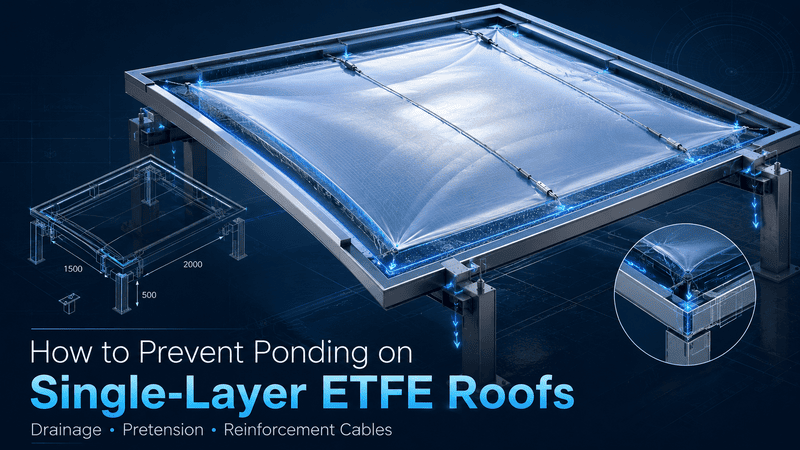
    Single-layer ETFE roofs are lightweight, transparent, and well suited to long-span architecture, but their drainage behavior is different from that of rigid metal or glass roofs. On a shallow, nearly flat ETFE panel, the main risk is not simply that the nominal slope looks small. The critical problem is a local depression that develops under rain load: water collects, the membrane deflects further, and the deeper depression attracts more water. That feedback loop is the mechanism behind roof ponding. This guide uses the BIM model, detail drawings, measured dimensions, and on-site rectification records from a 1:1 ETFE mock-up for Qingdao Youth Football Stadium to answer a practical design-and-construction question: how can a project team reduce single-layer ETFE roof ponding risk before large-area installation begins? Scope and design boundary Every dimension and construction detail below comes from the Qingdao Youth Football Stadium ETFE mock-up. Other projects must be designed for their own local design rainfall intensity, span, support…

  • Tensile Structure Installation: Step-by-Step Process Guide

    Tensile Structure Installation: Step-by-Step Process Guide

    Tensile structure installation involves much more than placing a membrane over a steel frame and pulling it tight. A successful project requires the foundations, anchor points, steel supports, cable system, membrane panels, connection hardware, and drainage details to work together as one coordinated system. The installation process normally includes site verification, steel erection, membrane inspection, lifting and positioning, initial connection, progressive membrane tensioning, final inspection, and project handover. A problem at any stage can affect the final membrane geometry, pretension distribution, connection safety, and drainage performance. Incorrect anchor locations may prevent a membrane panel from reaching its fixing points. Incorrect panel orientation may result in removal and reinstallation. An unsuitable tensioning sequence may create wrinkles, uneven loading, localized overstress, or unintended low points where water can collect. This step-by-step guide explains the complete tensile structure installation process in the order it usually takes place on site. It is intended to help project owners, architects, contractors, and site…

  • How to Choose the Best Tensile Membrane Structure Manufacturer: 10 Key Factors

    How to Choose the Best Tensile Membrane Structure Manufacturer: 10 Key Factors

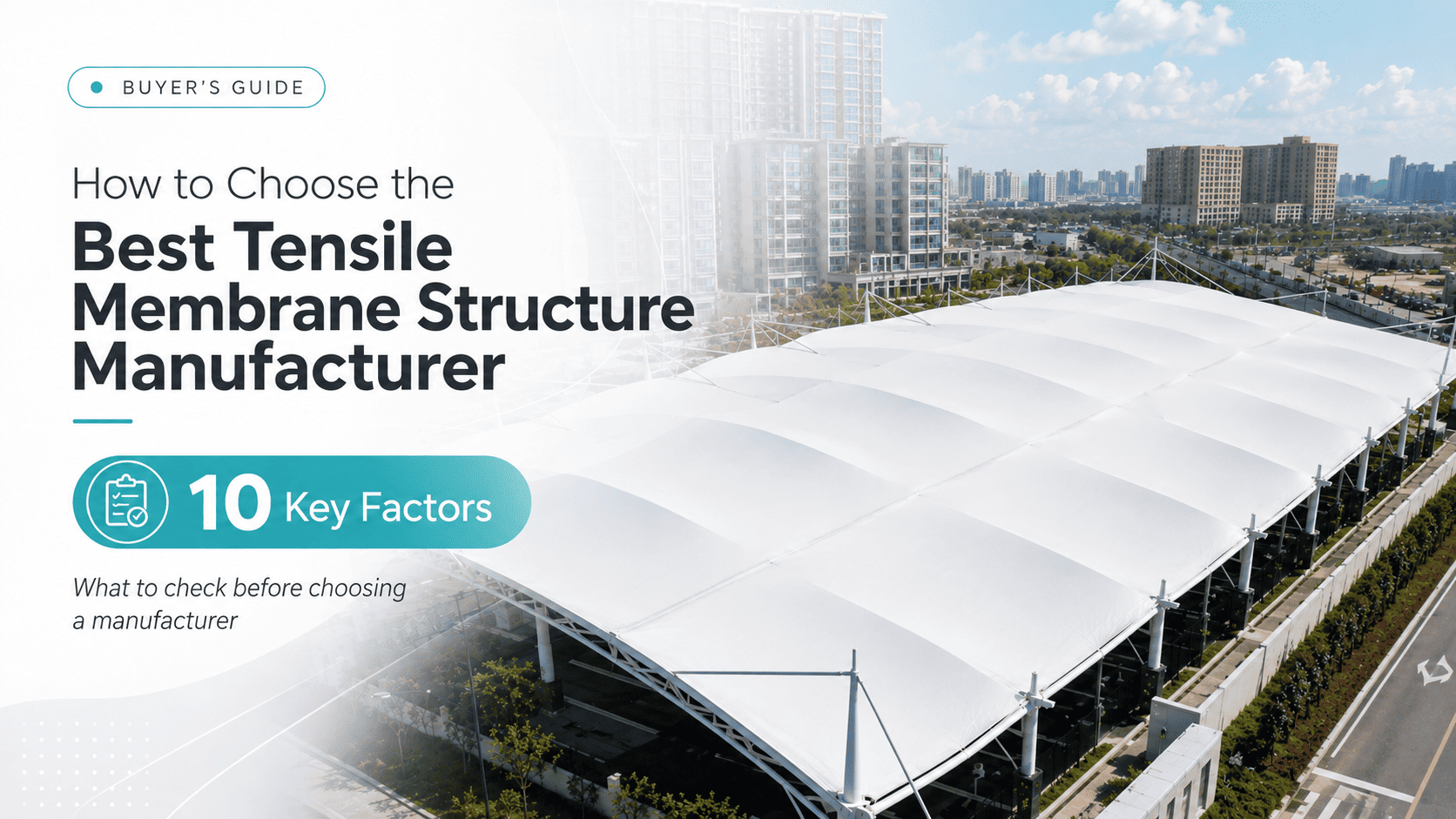
    Choosing a tensile membrane structure manufacturer should involve more than comparing prices, factory size, or project renderings. A tensile membrane structure is a coordinated engineering system involving architectural form, form-finding analysis, structural calculations, membrane fabrication, steelwork, cable systems, connection details, foundation interfaces and on-site installation. Even when high-quality membrane material is specified, inadequate structural analysis, drainage design, fabrication accuracy or tensioning control can still result in wrinkles, ponding water, structural deformation, installation delays and higher maintenance costs. The best tensile membrane structure manufacturer is one that can respond to the actual project location and site conditions with reliable engineering, clearly specified materials, verifiable manufacturing quality and well-defined installation and warranty responsibilities. This guide explains 10 key factors that project owners, architects, contractors and procurement teams can use to compare tensile structure manufacturers and reduce design, approval, manufacturing, shipping and installation risks. Technical note: This guide applies to tensile membrane carports, commercial canopies, stadium roofs, transportation facilities, landscape…

  • Tensile Membrane Structure Design Guide: Process, Materials, Cost, and Project Planning

    Tensile Membrane Structure Design Guide: Process, Materials, Cost, and Project Planning

    A tensile membrane structure is a lightweight spatial system in which the membrane, cables, supporting steelwork, connections, and initial prestress work together. These structures are widely used for car parks, entrance canopies, stadium stands, commercial plazas, transport facilities, and building atriums. Unlike a conventional rigid roof, the curved form of a tensile membrane is part of the load-bearing system. Changes to membrane curvature, prestress, support locations, or material properties can affect structural behavior, drainage, connection design, foundation reactions, installation methods, and overall project cost. For this reason, a buildable tensile structure cannot be developed by focusing only on appearance or comparing membrane prices alone. The membrane, cables, steel supports, connections, foundations, drainage, and site conditions must be evaluated as one coordinated system. What This Tensile Structure Guide Covers Common Project Question What You Will Learn How is a tensile membrane structure designed? The complete process, from project requirements and form-finding to fabrication, installation, and inspection. How do…

  • How much does a tensile membrane structure cost per square meter?

    How much does a tensile membrane structure cost per square meter?

    Learn how tensile membrane structure costs are calculated, from material area and design to installation. Yexing, a professional tensile membrane structure manufacturer, ensures precision engineering for durable tensile membrane architecture.

  • Three Top tensile Membrane Companies and Manufacturers with Their Key Features

    When your team finally decides to invest in a tensile fabric structure for your commercial district, public space, or building project, it’s time to find a reliable solution. While online platforms offer many options, the process can quickly become overwhelming—information is often scattered, vague, or promotional in nature. That’s why, in this article, I’ll share a curated list of top-tier tensile fabric structure manufacturers, along with key insights that go beyond surface-level specifications. Whether you’re focused on cost efficiency, durability, or custom design, this guide will help you save time. Catalog  Why is it crucial to choose the right manufacturer? List of manufacturers of three-layer tensioned fabrics and membrane structures Local supplier or overseas manufacturer? How to make a choice The Final Outcome FAQ Why is it crucial to choose the right manufacturer? Selecting the right tensile membrane structure manufacturer is like searching for a gem in the sand. In the world of tensile architecture, your supplier…

  • Tensile Membrane Structure Quantity Calculation Guide: Area & Cost | Yexing

    Tensile Membrane Structure Quantity Calculation Guide: Area & Cost | Yexing

    In the design of membrane structures, accurately calculating the area of the membrane structure is of great significance. By dividing the membrane structure into multiple small areas and performing numerical integration on each small area, and finally adding up the integration results of all small areas, the area of the entire membrane structure can be obtained. For instance, for the spherical mask structure, the formula for calculating the spherical area can be used for the calculation. For cylindrical membrane structures, the formula for calculating the cylindrical area can be used for the calculation. Although these regular area calculation methods are simple, they have certain practicality in actual engineering. In conclusion, there are many methods for calculating the area of membrane structures. The selection of an appropriate method depends on the shape, complexity and calculation accuracy requirements of the membrane structure. Calculation of membrane material area The core part of a membrane structure is the membrane material, and…

  • ETFE Inflatable Membrane Structure – Maintenance, Operation & Cleaning Guide

    ETFE Inflatable Membrane Structure – Maintenance, Operation & Cleaning Guide

    Similar to general curtain wall and roof systems, ETFE inflatable membrane structure systems require daily operation management, regular maintenance, repair and cleaning during use. The difference is that since the ETFE inflatable membrane structure system requires an inflation system to work under the control of an automatic monitoring system to ensure that the air pillow and the entire enclosure structure system always remain in normal working condition, it is necessary to conduct daily management and inspection of the operation of the entire system, as well as regular necessary maintenance and cleaning. On the other hand, due to the superior self-cleaning properties of ETFE membrane materials, its surface is not easy to absorb dust, so its cleaning cycle is longer than that of general glass curtain walls. The operation management and maintenance of the ETFE inflatable membrane structure system needs to be carried out by professional operators and maintenance personnel who have received systematic training in accordance with…

  • Maintenance methods for membrane structure buildings

    Maintenance methods for membrane structure buildings

    Scraper coating method for membrane structure building The blade coating method mainly uses a blade to apply a certain amount of coating liquid onto the cloth surface. The thickness of the coating is adjusted by the gap between the blade and the base cloth. The blade coating method is generally used to process relatively thin materials, and can be applied to both sides of the material to produce different coating materials. Roller method for membrane structure building The roller method mainly involves heating a coating solution and pressing it into a thin film using a heated roller. Several rollers are then used to combine the coating film with the substrate.The roller method is generally suitable for processing thicker coatings and can accurately adjust the thickness of the coating. Coating method of sculpture cylinder for membrane structure building The engraving roller coating method combines the blade coating and roller coating methods. The excess coating liquid is scraped off…

  • How to repair the damaged ETFE membrane structure air pillow?

    How to repair the damaged ETFE membrane structure air pillow?

    Due to the high strength and toughness of the ETFE membrane structure air pillow, the possibility of damage after installation on walls and roofs is very low, except for non human damage or other unexpected situations. Nevertheless, it is still necessary to consider countermeasures and maintenance plans in the event of damage. Yexing has been focusing on membrane structures for 16 years. This article is a summary of the maintenance experience of ETFE membrane structure air pillow damage by industry experts. We hope it can be helpful to you. Accidental damage to ETFE air cushions may occur in different situations and degrees, so targeted maintenance measures need to be taken. Generally, common damages are caused by external force scratches or sharp tool punctures, with different sizes and areas of the damaged surface. For smaller voids (diameter less than 30mm) or elongated scratches, special tape made of ETFE film can generally be used for repair. This type of…

WhatsApp

+852 69447081

Message Email

yexing01@yexingms.com

Top

Leave us a Message

We usually reply within 24 hours.

Contact Form