
ENCN

Yexing / blog / ETFE, PTFE & PVDF Materials

ETFE, PTFE & PVDF Materials

  • ETFE vs PTFE for Football Stadium Roofing: Which Should You Choose?

    ETFE vs PTFE for Football Stadium Roofing: Which Should You Choose?

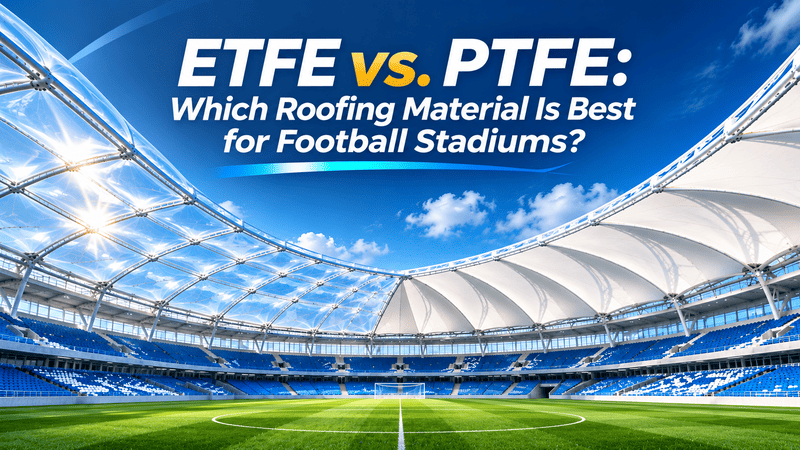
    A football stadium roof does more than shape a venue’s appearance. It also affects the amount of daylight reaching the pitch, spectator comfort, structural safety, and long-term maintenance costs. ETFE and PTFE are two commonly used membrane materials for stadium roofs, but each offers distinct advantages. So, which one is the better choice for your football stadium project? This article compares ETFE and PTFE in terms of light transmission, durability, structural performance, and cost. By looking at different football stadium requirements and real-world projects, it will help you understand the differences and identify a roofing solution that better suits your needs. ETFE or PTFE: Which Should You Choose for a Football Stadium Roof? ETFE and PTFE are both widely used in modern football stadium membrane roofing, but they differ significantly in material properties, light transmission, and typical applications. ETFE is a lightweight, transparent, or translucent fluoropolymer film that can be used in single-layer tensioned systems or multi-layer…
  • Single-Layer ETFE vs. ETFE Cushion Roofs: Which Should You Choose?

    Choosing between a single-layer ETFE roof and an ETFE cushion roof is not simply a matter of choosing one or more layers of film. Although both systems use lightweight, light-transmitting ETFE foil, they differ in how they are supported, how well they insulate, and what they cost to operate and maintain. If you need a roof mainly for rain protection and daylight over an open or semi-open space, a single-layer ETFE system may be a practical starting point. If your project is an enclosed atrium, greenhouse, or skylight where indoor temperature matters, an insulated ETFE cushion system is often worth considering. Some projects use both. This guide compares the two roof systems in plain English and uses real Yexing projects to show where single-layer ETFE and inflated cushions make sense. What Is the Difference Between Single-Layer ETFE and ETFE Cushion Roofs? The main difference is how the ETFE film is supported and whether the roof uses an…

  • A Large Tensile Membrane Roof vs. a Traditional Roof: Which Is Better for Your Project?

    A Large Tensile Membrane Roof vs. a Traditional Roof: Which Is Better for Your Project?

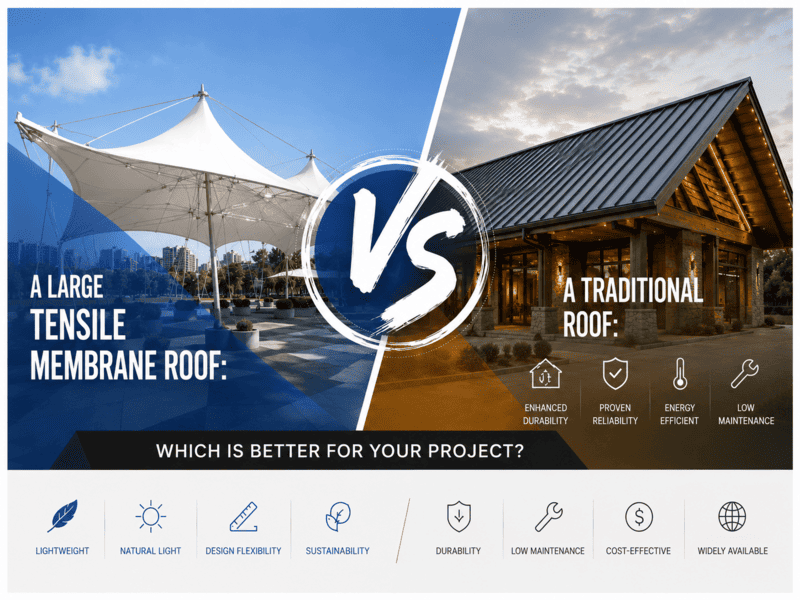
    Choosing between a tensile membrane roof and a traditional roof is not about finding one system that is better in every situation. It is about finding the roof that fits your project. A tensile membrane roof is often a better fit for large spans, lightweight structures, semi-open spaces, and projects where the roof is part of the architectural identity. A traditional roof is often a better fit for enclosed buildings that need strong thermal insulation, acoustic control, regular roof access, and standard construction details. The right choice depends on span, building use, structural load, climate, installation conditions, maintenance needs, and total project cost. This guide compares both systems from a project owner’s point of view. Tensile Membrane Roof vs. Traditional Roof: What Are the Main Differences? A traditional roof usually uses rigid structural members and conventional roof layers. Common examples include metal roofing, insulated sandwich panels, concrete roofs, and tiled roofs. A tensile membrane roof works differently….

  • Tensile Membrane Structure vs. Steel Structure: Which Is Better for Your Project?

    Tensile Membrane Structure vs. Steel Structure: Which Is Better for Your Project?

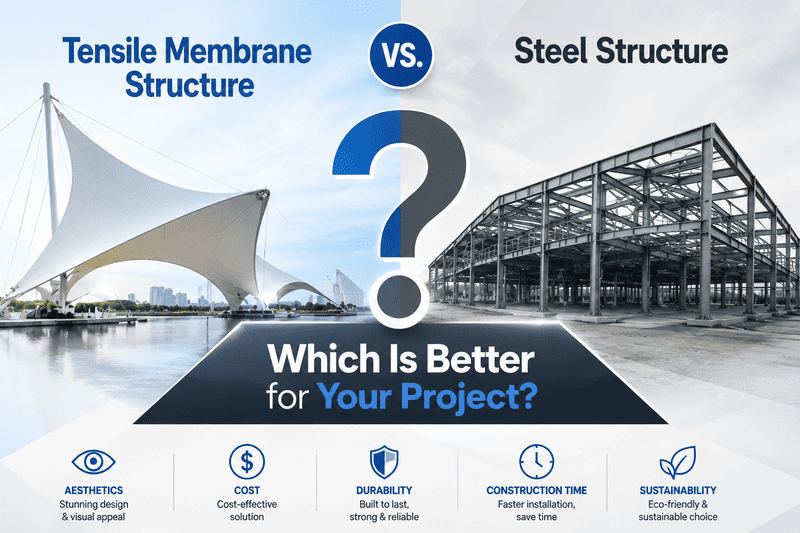
    For long-span projects such as stadium grandstand roofs, commercial plazas, carports, transportation hubs, warehouses, and industrial buildings, a tensile membrane structure and a steel structure are often compared side by side. For you as a project owner, the real question is not which system is “better” in general. The better choice is the one that fits your project use, span, loads, budget, schedule, architectural goals, and long-term maintenance needs. The comparison below explains the main differences between tensile membrane structures and steel structures. It covers structural weight, long-span capability, load capacity, enclosure, design freedom, natural daylight, construction time, total project cost, durability, and maintenance. You will also find practical selection guidance for different project types. Tensile Membrane Structure vs. Steel Structure: Key Differences at a Glance Comparison Criteria Tensile Membrane Structure Conventional Steel Structure Best-Suited Functions Open or semi-open shade and rain-protection coverage Fully enclosed, industrial, warehouse, and heavy-load buildings Structural Self-Weight Lightweight roof system; often helps…

  • What Is ETFE Membrane? Properties, Applications, Structure Types and Design Guide

    What Is ETFE Membrane? Properties, Applications, Structure Types and Design Guide

    ETFE membrane — also called ETFE foil, ethylene tetrafluoroethylene film, or ETFE architectural membrane — is a high-performance fluoropolymer-based transparent building material used for lightweight roofs, façades, and skylight systems. Originally developed for the aerospace industry, ETFE membrane has become one of the most widely adopted material innovations in modern architecture, appearing everywhere from Olympic stadium roofs to airport terminal canopies and commercial atrium skylights. Walk through any major city’s new developments, and you’ve almost certainly stood under ETFE without knowing it. That impossibly light canopy at the airport? The bubble-like roof over the sports arena? The atrium that somehow feels open to the sky while keeping the rain out? That’s ETFE membrane. It’s not glass. It’s not plastic sheeting. And it’s definitely not what most people picture when they hear the words “architectural membrane.” This guide covers what ETFE membrane actually is, how the different ETFE structure types work, where ETFE makes sense (and where it…

  • What Is PTFE Tensile Membrane? Properties, Cost, Applications & Comparison Guide

    What Is PTFE Tensile Membrane? Properties, Cost, Applications & Comparison Guide

    If you’re planning a stadium, an airport terminal, a train station canopy, or a big commercial roof, someone has probably already mentioned “PTFE membrane” to you. Maybe you’ve seen photos of those crisp white tensile roofs and wondered if that’s what your project needs. Maybe a contractor sent you a quote, and the number made your eyes water. This guide is for you. No marketing fluff. No AI-generated filler about “unlocking the power of architectural fabrics.” Just the real answers to the questions people ask us after 18 years of designing, fabricating, and installing PTFE membrane structures across four continents. PTFE tensile membrane is a glass-fiber fabric coated with PTFE (the same fluoropolymer as Teflon). Installed correctly, it forms a lightweight, self-cleaning, fire-safe roof that lasts 25 to 35 years. It costs more upfront than PVC or PVDF membranes. Over 30 years, it’s usually the cheapest option. That’s the 30-second version. The rest of this page explains…

  • What Is PVDF Tensile Fabric? Properties, Structure, Advantages, and Applications

    What Is PVDF Tensile Fabric? Properties, Structure, Advantages, and Applications

    PVDF tensile fabric — also called PVDF membrane — is a high-performance architectural fabric composed of three bonded layers: a load-bearing polyester woven base, a waterproof PVC coating, and a polyvinylidene fluoride (PVDF) fluoropolymer topcoat that provides UV resistance, self-cleaning capability, and a 15 to 25-year service life. It is the most widely specified membrane material in tensile architecture worldwide, used in stadium roofs, airport canopies, commercial atriums, and public shade structures. But what separates a proper architectural-grade PVDF tensile fabric from a basic PVC tarp that looks terrible in three years? How do you choose between weldable and non-weldable grades, or between PVDF, PTFE, and ETFE? We’re a Shenzhen-based membrane structure engineering company with Special Grade qualifications in design, fabrication, and installation — the highest industry tier — and over three million square meters of completed tensile membrane projects since 2008. Here’s what we’ve learned about PVDF from working with it on real projects across China,…

  • PTFE vs PVDF vs ETFE: Which Tensile Membrane Material Is Best for Your Project?

    PTFE vs PVDF vs ETFE: Which Tensile Membrane Material Is Best for Your Project?

    Tensile membrane materials such as PTFE, PVDF, and ETFE are widely used in modern architectural engineering. Each offers distinct advantages in durability, transparency, cost, and structural performance, making them suitable for stadiums, airport terminals, commercial complexes, parking canopies, and other large-span structures. Choosing the right material depends on project requirements, budget, and design goals. This article provides a clear comparison of PTFE, PVDF, and ETFE membranes, helping architects and engineers make informed decisions.   What Are Tensile Membrane Materials? Tensile membrane materials are lightweight architectural fabrics or films designed to work under tension. They are widely used for long-span roof systems due to their: High strength-to-weight ratio Flexible architectural form Excellent daylight performance (especially ETFE) Efficient structural spanning capability PTFE vs PVDF vs ETFE Tensile Membrane Materials: Comparison Overview This table summarizes the key differences between PTFE, PVDF, and ETFE to help architects and engineers quickly select the most suitable tensile membrane material. Feature PTFE PVDF ETFE…

  • What is an airbag membrane structure?

    What is an airbag membrane structure?

    An air-filled membrane structure is an architectural structure primarily composed of flexible membrane materials, which are inflated to form a spatial structure with a specific shape and load-bearing capacity. This structure relies mainly on internal gas pressure to maintain the shape of the membrane material and withstand external loads. The membrane material is typically selected from high-strength, weather-resistant, and flexible materials, such as polyvinyl chloride (PVC) coated fabrics and ethylene-tetrafluoroethylene copolymer (ETFE). These materials not only meet the structural strength requirements but also possess excellent airtightness, ensuring the stable maintenance of internal gas pressure. Spherical and Hemispherical Shapes These designs are commonly found in small inflatable structures, such as inflatable domes. They are shaped like complete spheres or hemispheres, offering excellent spatial integrity and symmetry. They provide a large internal space and relatively uniform stress distribution, effectively dispersing external loads. Cylindrical These cylindrical, air-filled membrane structures typically have a regular rectangular appearance and are commonly used in…

  • What is a tensile structure? PVC  and PTFE membrane material

    What is a tensile structure? PVC and PTFE membrane material

    Tensile structures weigh only one-thirtieth of traditional structures. Furthermore, they overcome the challenges of traditional structures in large-span, unsupported buildings. Tensile structures are lightweight, easy to manufacture, and quick to install, making them widely used worldwide. With the continuous development and progress of the membrane structure industry, various types of membrane materials have flooded the market. Membrane materials used in construction engineering are mainly divided into two categories: fabric-based membrane materials and non-fabric-based membrane materials. Fabric-based membrane materials typically include polyvinyl chloride (PVC) membrane materials and polytetrafluoroethylene (PTFE) membrane materials. Today, we will learn about these two types of membrane materials. PTFE Membrane: PTFE membranes can be divided into clothing membranes, air filtration membranes, and air purification membranes according to their application areas. PTFE membranes have a fibrous microporous structure with a porosity exceeding 85%, containing 1.4 billion micropores per square centimeter, with pore sizes ranging from 0.02μm to 15μm. PVC Membrane: Polytetrafluoroethylene (PTFE) Clothing Film: Due…

WhatsApp

+852 69447081

Message Email

yexing01@yexingms.com

Top

Leave us a Message

We usually reply within 24 hours.

Contact Form