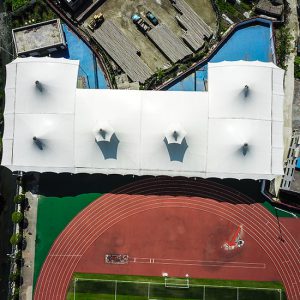
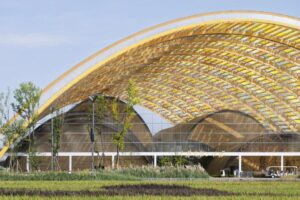
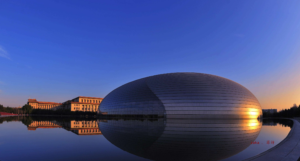
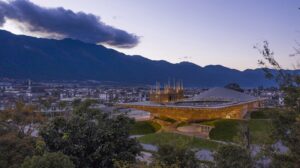
Tensile structures weigh only one-thirtieth of traditional structures. Furthermore, they overcome the challenges of traditional structures in large-span, unsupported buildings. Tensile structures are lightweight, easy to manufacture, and quick to install, making them widely used worldwide.
With the continuous development and progress of the membrane structure industry, various types of membrane materials have flooded the market. Membrane materials used in construction engineering are mainly divided into two categories: fabric-based membrane materials and non-fabric-based membrane materials. Fabric-based membrane materials typically include polyvinyl chloride (PVC) membrane materials and polytetrafluoroethylene (PTFE) membrane materials. Today, we will learn about these two types of membrane materials.
PTFE Membrane: PTFE membranes can be divided into clothing membranes, air filtration membranes, and air purification membranes according to their application areas. PTFE membranes have a fibrous microporous structure with a porosity exceeding 85%, containing 1.4 billion micropores per square centimeter, with pore sizes ranging from 0.02μm to 15μm.
PVC Membrane:
Polytetrafluoroethylene (PTFE) Clothing Film: Due to its extremely small pore size and irregular longitudinal curvature, wind cannot pass through, thus providing windproof and heat-insulating properties.
When laminated with other fabrics, it is widely used in military uniforms, medical clothing, casual wear, fire-fighting suits, protective clothing, underwater work suits, and other special protective clothing; outdoor sportswear; footwear, hats, gloves, and other accessories; as well as materials for sleeping bags, tents, and rain gear.
Polytetrafluoroethylene (PTFE) Air Filter Membrane: Products made with this membrane have a filtration efficiency of up to 99.99%, almost zero emissions; low operating resistance, fast filtration speed; long service life, and reusability, thus reducing operating costs.
It can be used for flue gas filtration in various industrial furnaces in chemical, steel, metallurgical, carbon black, power generation, cement, and waste incineration industries.
Polytetrafluoroethylene Air Purification Membrane
II. Polytetrafluoroethylene (PTFE) Membrane Structure
Classification of Polyvinyl Chloride (PVC) Films: PVC can be divided into flexible PVC and rigid PVC. Rigid PVC accounts for approximately two-thirds of the market share, while flexible PVC accounts for about one-third.
Flexible PVC is generally used for flooring, ceilings, and leather surfaces. However, due to the presence of plasticizers in flexible PVC (which is the difference between flexible and rigid PVC), it is prone to brittleness and difficult to preserve, thus limiting its application range.
Rigid PVC does not contain plasticizers, therefore it has advantages such as good flexibility, ease of molding, resistance to breakage, non-toxicity, non-polluting properties, and long shelf life, making it highly valuable for development and application.
The essence of PVC is vacuum thermoformed film, used for surface packaging of various panels, hence also called decorative film or adhesive film, and applied in many industries such as building materials, packaging, and pharmaceuticals. The building materials industry accounts for the largest share, reaching 60%, followed by the packaging industry, in addition to some other smaller-scale applications.
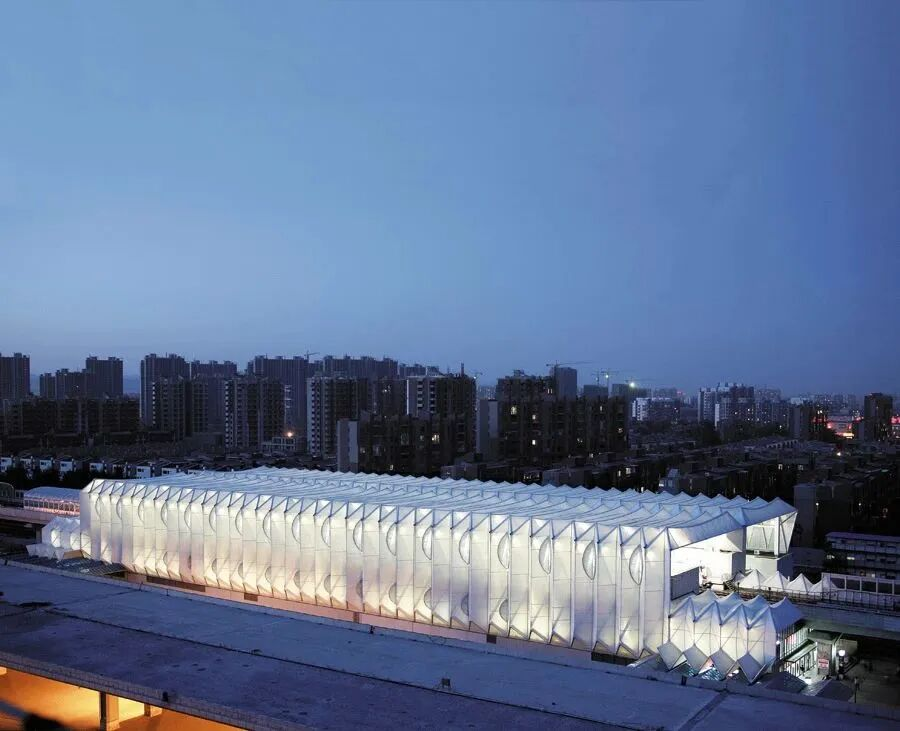
Material Characteristics
I. Excellent Properties of Polytetrafluoroethylene (PTFE) Membrane:
High strength, with a tensile strength exceeding 7000 N/5 cm, meeting the load requirements of large-span spaces. Even stronger and more durable than steel wire of the same diameter;
Lightweight, accounting for only a small fraction of traditional building materials, weighing no more than 1.5 kg per square meter;
Good flexibility, can be stretched into various dynamic arc shapes;
Transparent: During the day, incident light becomes natural diffused light, without shadows, with a solar reflectivity of 73%, absorbing less heat;
Strong self-cleaning ability, almost no dust accumulation, and solid substances cannot adhere to its surface, making it easy to clean;
High chemical stability, resistant to chemical corrosion, and able to withstand strong acids, strong alkalis, aqua regia, and various organic solvents.
II. Characteristics of PVC Membrane Material:
Soft material, good flexibility, easy to mold, and easy to construct;
High strength, good fire resistance, service life generally 7 to 15 years, and long storage time;
The raw materials of PVC membrane are specially refined, non-toxic and odorless, with all toxic substances completely removed, making it completely non-toxic and odorless.
Polytetrafluoroethylene (PTFE) membrane is a high-molecular polymer polymerized from tetrafluoroethylene. It is a microporous film manufactured through special processes such as lamination, extrusion, and biaxial stretching, and is also known as the “king of plastics.”
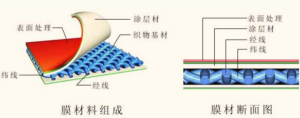
Polyvinyl chloride (PVC) membrane, also known as polyvinyl chloride, is abbreviated as PVDF membrane material. Its main component is polyvinyl chloride. It is a slightly yellow, translucent, and glossy substance. This surface film has a coating layer on the surface, a polyvinyl chloride middle layer, and a backing adhesive layer.
It is a composite material made by coating polyvinyl chloride (PVC) resin onto a polyester fiber woven base fabric.
She has over 20 years of experience in tensile membrane structure design, engineering, and manufacturing, with extensive expertise in delivering custom solutions for commercial and architectural projects.