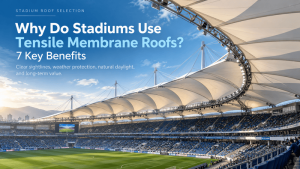
ETFE and PTFE are two commonly used membrane materials for stadium roofs, but each offers distinct advantages. So, which one is the better choice for your football stadium project?
This article compares ETFE and PTFE in terms of light transmission, durability, structural performance, and cost. By looking at different football stadium requirements and real-world projects, it will help you understand the differences and identify a roofing solution that better suits your needs.
ETFE or PTFE: Which Should You Choose for a Football Stadium Roof?
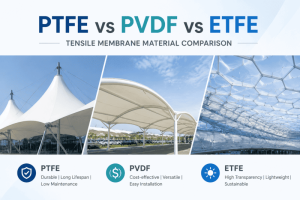
ETFE and PTFE are both widely used in modern football stadium membrane roofing, but they differ significantly in material properties, light transmission, and typical applications.
ETFE is a lightweight, transparent, or translucent fluoropolymer film that can be used in single-layer tensioned systems or multi-layer cushion systems. It is well suited to roofs designed to admit natural daylight and create an open, transparent appearance.
PTFE in this context generally refers to PTFE-coated fiberglass fabric, which offers good weather resistance, tensile strength, and shading performance. It is commonly used for stadium grandstands and large-span tensile membrane roofs.
So which is more suitable for a football stadium roof? If your priority is natural daylight, sufficient light for natural grass, and architectural transparency, ETFE is worth considering first.
If you place greater importance on spectator shade, soft, diffused light, and long-term weather resistance, PTFE is often the more suitable choice. For large football stadiums that need both pitch daylight and shaded seating, the two materials can also be combined in different roof zones according to their functions.
However, there is no single material that is best for every football stadium roof. The right choice depends on the project. Alongside light transmission and shade, you need to consider the local climate, wind and snow loads, roof structure, construction budget, and future maintenance. The following comparison examines these factors in more detail to support a practical material selection.
Key Differences Between ETFE and PTFE Football Stadium Roofs
Both ETFE and PTFE can be used for football stadium membrane roofs, but they differ in daylight performance, shading, structural systems, and long-term costs. ETFE stands out for its low weight and natural-light potential, while PTFE is particularly well suited to shading, diffused daylight, and large-span tensile roof designs.
The table below compares the two materials across nine important criteria. Actual performance will depend on the membrane grade, roof construction, and detailed engineering design.
| Comparison factor | ETFE film roof | PTFE-coated fiberglass membrane roof |
|---|---|---|
| Material and appearance | Transparent or translucent film; available in single-layer or cushion systems, with a light, open appearance. | Typically a white or off-white fabric membrane, suitable for flowing, large-span roof forms. |
| Natural daylight | Clear grades have high light transmission and can help bring more daylight to natural-grass pitch areas. | Typically lower light transmission, often providing softer, more diffused daylight. |
| Shading and thermal comfort | Printing and tinting can be used to control light and shade, but solar heat gain needs to be considered. | Typically provides effective shade, helping reduce direct sunlight and glare. |
| Weight and structural system | Lightweight film used in single-layer tensioned or multi-layer cushion systems. | Relatively heavier fabric membrane, usually installed in a tensile system supported by steelwork or cable nets. |
| Wind and snow resistance | Good flexibility; actual resistance depends on the overall structural design. | Fiberglass reinforcement provides high tensile strength; actual load capacity also depends on the structure and connection details. |
| Fire, thermal, and acoustic performance | Fire classification must be confirmed for the specific product; multi-layer cushions can improve thermal insulation. | Fire performance must be confirmed for the specific product; single-layer membranes generally offer limited thermal and acoustic insulation. |
| Durability and service life | Good UV and weather resistance, making it suitable for long-term outdoor use. | Good weathering and aging resistance, backed by extensive experience in long-term architectural applications. |
| Installation and maintenance | Single-layer systems are relatively straightforward; cushion systems also require maintenance of air-supply equipment and seals. | Requires proper membrane prestress and periodic inspection of connections, the membrane surface, and drainage. |
| Overall construction cost | Includes the membrane, supporting structure, any cushion equipment, and maintenance. | Includes the membrane, steel or cable supports, installation, and long-term maintenance. |
1. Light Transmission and Shading: How They Affect Pitch Grass and Spectator Comfort
For a natural-grass football stadium, sufficient daylight is important for healthy turf growth. Clear ETFE allows more sunlight into the stadium and is therefore well suited to roof areas where daylight is a priority.
However, high light transmission does not automatically mean that the pitch will receive enough sunlight. Stand height, roof geometry, sun angles, and seasonal changes must also be taken into account.
PTFE, by comparison, is often a better fit for spectator stands where shading is the primary requirement. It can reduce direct sunlight while admitting softer, diffused light, helping to limit glare and improve the daytime match experience. PTFE is not necessarily completely opaque, however; its actual light transmission depends on the membrane specification.
For stadiums that need both natural light for the grass and shade for spectators, using different materials in different roof zones may make more sense than covering the entire stadium with a single material.
2. Construction Cost: Look Beyond the Price of the Membrane
Which is cheaper, ETFE or PTFE? This is often one of the first questions asked by football stadium owners and purchasing teams.
In practice, the total roof cost depends on much more than the membrane’s unit price. Supporting structures, installation methods, and maintenance requirements all matter.
For example, a single-layer ETFE roof has a different cost structure from a multi-layer ETFE cushion system, which also needs air-supply equipment, controls, and ongoing operating expenditure. A PTFE tensile roof, meanwhile, must be assessed together with its steelwork, cable nets, connection details, and installation costs.
To establish which option is more economical, compare complete roof systems designed for the same project conditions, taking both initial construction costs and long-term maintenance into account.
3. Safety, Durability, and Maintenance: The Complete Roof System Matters
Football stadiums are large public buildings, so roof safety and long-term performance are critical. Both ETFE and PTFE offer good weather resistance, but wind and snow capacity, fire performance, and service life cannot be determined by the material name alone. These must be evaluated against the specific membrane grade, structural design, and applicable local building codes.
Both materials also have limitations when used as single-layer roofs in terms of thermal and acoustic insulation. Multi-layer ETFE cushions can improve thermal performance, but their air-supply equipment and sealing systems require regular maintenance. PTFE tensile roofs need particular attention to membrane tension, connection details, and drainage.
For owners, the decision should take account of more than how the roof looks when completed. It should also reflect future inspection work, maintenance needs, and operating costs. Reviewing the construction details of ETFE membrane roof systems and PTFE tensile membrane roof systems can help you make a more informed comparison.
Overall, ETFE is better suited to football stadium roofs that prioritize natural daylight and a transparent appearance, while PTFE is particularly suitable for grandstand roofs that emphasize shade and expressive tensile forms.
Which system is more cost-effective or durable will ultimately depend on the structure and operating conditions. The next section explains how to choose for different types of football stadiums.
How to Choose ETFE or PTFE for Different Types of Football Stadiums
Different football stadiums have different roofing needs. Natural-grass pitches require careful attention to sunlight, open-air stands need shade and rain protection, and more enclosed stadium designs may place greater emphasis on daylight and indoor comfort. The first step is therefore to define your stadium type, operational needs, and local climate.
1. Natural-Grass Football Stadiums: Consider ETFE for Better Daylight
Natural grass needs sufficient sunlight to grow well. For football stadiums with extensive roof coverage or areas of the pitch that are heavily shaded, clear ETFE is often worth considering. Its high light transmission allows more daylight to enter the stadium and can help improve conditions for the turf.
However, the light actually reaching the grass also depends on roof geometry, stand height, building orientation, and seasonal changes. Designers should use sunlight studies to determine where ETFE will be most effective, rather than automatically specifying a transparent membrane across the entire roof.
2. Open-Air Football Stadium Grandstands: PTFE for Shade and Rain Protection
In an open-air football stadium, spectator stands usually need protection from sun and rain while maintaining good ventilation. PTFE membrane roofing is often a suitable option. Its shading performance can reduce direct sunlight and glare, creating a more comfortable viewing environment.
PTFE-coated fiberglass also offers good weather resistance and tensile strength. Used with steelwork or cable nets, it can create smooth, large-span roof forms. Even so, proper drainage slopes, supporting structures, and connection details are essential to reliable long-term performance.
3. Semi-Enclosed or Enclosed Football Stadiums: Balance Daylight and Thermal Comfort
For semi-enclosed or enclosed football stadiums, single-layer ETFE or multi-layer ETFE cushions may be advantageous where the design calls for a bright, open atmosphere. These systems can admit natural daylight while keeping the membrane itself lightweight, supporting a modern architectural appearance.
In hot or high-sunlight climates, however, large areas of transparent roofing may increase solar heat gain inside the stadium. Printed ETFE shading, ventilation, and insulation should therefore be considered together to balance daylight with thermal comfort. PTFE is also worth evaluating when shade is the main priority.
4. Different Climates: Focus on Environmental Performance
Local weather conditions can have a major influence on the choice between ETFE and PTFE for a football stadium roof.
Hot and sunny regions
Prioritize shade, glare control, and thermal comfort. PTFE often has an advantage, while ETFE may require additional shading measures.
Cold and snowy regions
Pay particular attention to insulation requirements, snow loads, and drainage. Multi-layer ETFE cushions may be one insulation option, but project-specific structural calculations are still necessary.
High-wind and typhoon-prone regions
Both materials can be used, provided membrane prestress, supporting structures, connection details, and the overall wind-resistance design meet local requirements.
Remember that wind and snow resistance depends on the combined performance of the membrane and the complete structural system, not on the membrane material alone.
5. Large Professional Football Stadiums: Consider Combining ETFE and PTFE
For large football stadiums with complex functional requirements, the choice does not necessarily have to be ETFE or PTFE. ETFE can be used in areas where natural daylight is important, while PTFE can be applied above spectator seating where shade is needed.
For example, some projects may consider an inner ring of ETFE and an outer ring of PTFE to improve daylight for natural grass while providing shade for spectators. The precise arrangement must be assessed against roof geometry, structural connections, waterproofing details, and the available budget.
In summary, ETFE is well suited to football stadiums that value natural daylight and transparency, while PTFE is a strong option for projects prioritizing shade and tensile roof forms. Where both requirements are important, a combined approach may be more effective. The following project examples illustrate how membrane materials can be selected for real stadium roofing needs.
Real Project Examples: How Are ETFE and PTFE Used in Stadium Roofing?
After comparing the properties of ETFE and PTFE, real projects can provide a clearer picture of how the materials are used. The following two large stadium projects involving Yexing illustrate how different roofing priorities influence material selection.
1. Qingdao Youth Football Stadium: A Lightweight, Transparent ETFE Roof
Qingdao Youth Football Stadium is Shandong Province’s first purpose-built football stadium with approximately 50,000 seats. Inspired by the idea of “rolling ocean waves,” the building combines an outer roof of aluminum-magnesium-manganese metal panels with transparent and frosted ETFE film along the inner roof area, creating a layered architectural effect.
The project uses a single-layer ETFE membrane system with an area of approximately 23,687 m² and a film thickness of 250 μm. As an ETFE membrane structure supplier, Yexing was involved in detailed membrane design, material coordination, and construction installation.
This project demonstrates the advantages of ETFE in large football stadium roofs where natural daylight is important. Combining ETFE with metal roofing supports a distinctive building form while allowing more daylight through selected areas of the roof, creating better opportunities to address natural-grass lighting needs.
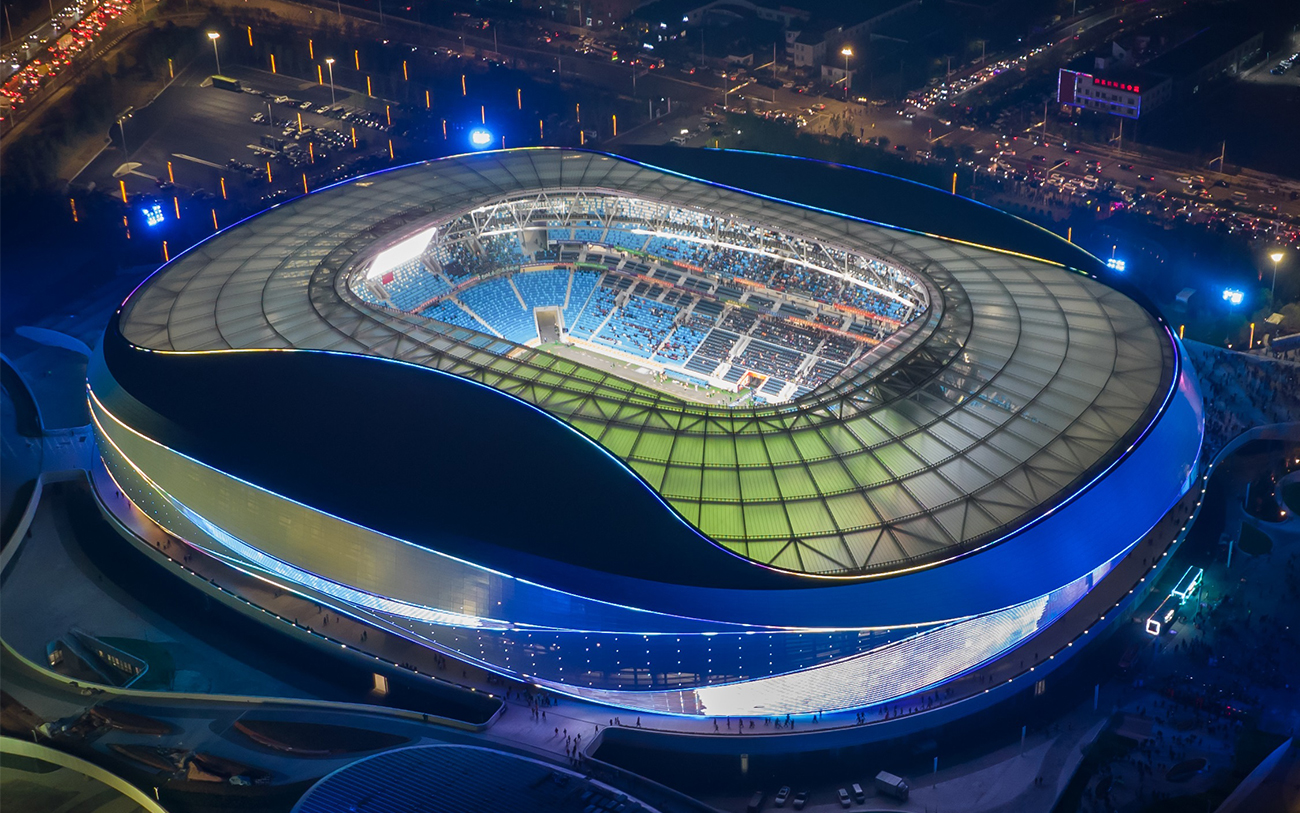
Key takeaway: ETFE is worth considering for football stadiums seeking a balance of natural daylight, lightweight construction, and a modern appearance. However, the extent and location of ETFE should still be determined by stadium geometry and sunlight conditions.
To learn more about the roof structure, membrane specification, and completed appearance, see the Qingdao Youth Football Stadium ETFE membrane roofing project.
2. Leshan Olympic Center: A Large-Span PTFE Flexible Cable-Supported Roof
Leshan Olympic Center is a major multi-purpose sports development in Sichuan Province, China, with approximately 30,000 seats in its main stadium. The stadium roof uses white PTFE architectural membrane and a flexible cable-supported system to create a continuous, flowing, large-span elliptical form.
Yexing was responsible for the membrane roof’s detailed design and construction. To manage installation more effectively, the roof was divided into 42 membrane units. Because of the complex cable-net system, accurate membrane cutting, connection details, and on-site installation required careful coordination.
The project demonstrates the value of PTFE membrane in large-span stadium roofing. In combination with cable nets and steel structures, PTFE can form complex curved roofs while meeting key requirements for spectator shade, rain protection, and long-term outdoor use.
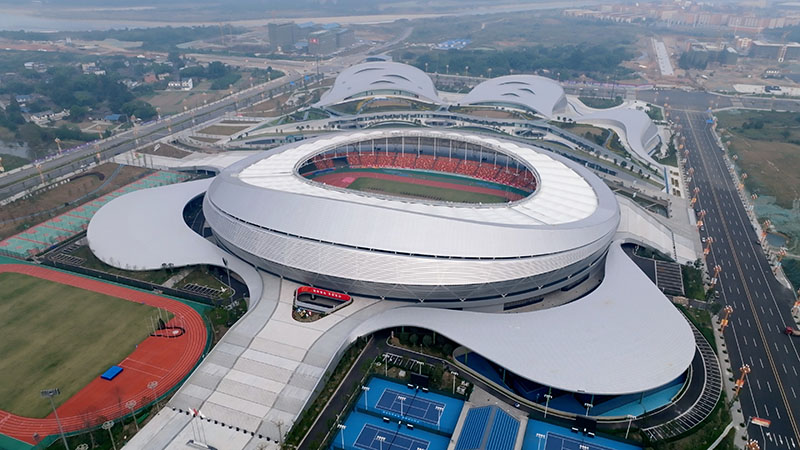
Key takeaway: For stadium projects that emphasize large-span coverage, spectator shade, and flowing architectural forms, PTFE tensile membrane roofing is an option worth evaluating early in the design process.
If you are planning a similar large-span stadium roof, the Leshan Olympic Center PTFE membrane structure project offers a useful reference for roof configuration and construction methods.
3. What Can We Learn from These Two Projects?
Qingdao Youth Football Stadium and Leshan Olympic Center use different membranes and structural systems, illustrating why there is no one-size-fits-all solution for stadium roofing.
ETFE places greater emphasis on natural daylight and architectural transparency, while PTFE is well suited to shaded, large-span roofs with complex tensile structures. In either case, actual performance still needs to be assessed against the project’s requirements.
For football stadium owners and design teams, the value of looking at completed projects is not to copy their material choices, but to identify a roof solution that better fits the venue’s function, architectural design, and budget.
Football Stadium Roofing Selection Guide: Five Questions to Answer Before Contacting a Supplier
Choosing ETFE or PTFE involves more than comparing material properties. You also need to consider how the football stadium will be used, the construction budget, and long-term maintenance. Before requesting a design recommendation or quotation, clarify these five points:
1. Stadium use
Will the football stadium be used mainly for professional matches, regular training, or multi-purpose events such as concerts? Different uses may call for different daylight, shading, and performance requirements.
2. Pitch type and roof coverage
Will the stadium have natural or artificial turf? Will the roof cover only spectator seating, or extend over part of the playing area? These factors directly affect the suitability of ETFE and PTFE.
3. Local climate and building requirements
Where is the project located? Will the roof face intense sunlight, high winds, heavy snow, or extreme temperatures? Local structural and fire-safety requirements also need to be considered.
4. Roof structure and construction conditions
What are the proposed span, height, and roof shape? Are architectural drawings or preliminary design plans already available? This information helps suppliers evaluate system options, installation complexity, and construction schedules.
5. Construction budget and long-term maintenance
What is the available budget? Are there specific expectations for service life, inspection frequency, or operating costs? Planning should account for both initial investment and ongoing expenditure.
How Can You Get a More Accurate ETFE or PTFE Roofing Quote?
Provide the supplier with the information above and, where practical, ask for comparable ETFE and PTFE roof proposals. Look beyond the membrane price per square meter. Compare natural-light and shading performance, supporting structures, installation costs, maintenance requirements, and the overall project cost.
Still unsure which material is best for your football stadium? If you already have a concept drawing, preliminary design, or clear roofing requirements, you can discuss them with Yexing Membrane Structures. By reviewing the venue’s intended use, climate, roof structure, and budget together, the team can help you evaluate the suitability of ETFE and PTFE for your football stadium roof.
Conclusion
ETFE and PTFE each have distinct strengths, and the right choice depends on the needs of your football stadium. If natural daylight, turf lighting, and a transparent architectural appearance are your main priorities, ETFE is often the more suitable option.
If spectator shade, diffused daylight, and large-span tensile roof forms matter more, PTFE deserves serious consideration. For large football stadiums with complex requirements, a combination of the two materials may help meet the needs of different areas.
Whichever material you select, consider the local climate, structural safety, construction budget, and long-term maintenance to ensure that the roofing solution performs well both now and over the years ahead.
Planning a new football stadium roof or renovating an existing one?
Contact Yexing Membrane Structures and share your project location, stadium type, and initial design requirements. You can discuss ETFE and PTFE options and explore a membrane roofing solution tailored to your football stadium project.
FAQ
Which Football Stadium Roof Is Quieter in the Rain: ETFE or PTFE?
ETFE cushion roofs may produce noticeable rain-impact noise during heavy rainfall, although acoustic layers can help reduce it. Rain noise on a PTFE roof depends on the membrane system and acoustic design, so it is not necessarily quieter in every situation.
If the football stadium will also host concerts or major events, compare the acoustic performance of both proposed roofing systems at the design stage.
Which Is Easier to Clean, an ETFE or a PTFE Football Stadium Roof?
Both ETFE and PTFE offer good resistance to dirt, and rainwater can wash away some surface dust. ETFE has a smooth surface, while PTFE coatings also resist dirt adhesion. However, both materials may need periodic cleaning in areas with heavy air pollution or limited rainfall. Actual maintenance requirements depend mainly on roof slope, drainage design, and local environmental conditions.
Which Football Stadium Roof Is Easier to Repair if Damaged?
Both systems can be repaired or replaced locally depending on the type and extent of damage. In modular ETFE cushion roofs, individual damaged cushions can often be replaced. PTFE tensile membranes may also be repaired or replaced by membrane section. Repair difficulty depends primarily on the damage location, connections, and site access rather than on the membrane material alone.
Which Is Better for Football Stadium Night Lighting, ETFE or PTFE?
ETFE can create a transparent, modern night-time appearance when used with a suitable lighting system. PTFE, typically white or off-white, can highlight the roof’s curves through external lighting and may also support backlighting effects depending on its light transmission. The better choice depends on the stadium’s architecture and lighting design.
Which Is More Environmentally Friendly for Football Stadium Roofing, ETFE or PTFE?
ETFE is a thermoplastic material with the technical potential for recycling and reprocessing. PTFE-coated fiberglass is a composite material and is generally more difficult to recycle.
However, whether a material can actually be recycled depends on the facilities available locally. When assessing a football stadium roof’s environmental impact, consider manufacturing, the amount of supporting structure required, service life, maintenance, and end-of-life treatment.

She has over 20 years of experience in tensile membrane structure design, engineering, and manufacturing, with extensive expertise in delivering custom solutions for commercial and architectural projects.