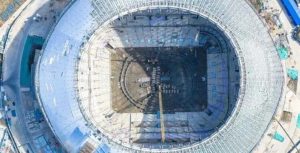
PVDF tensile fabric — also called PVDF membrane — is a high-performance architectural fabric composed of three bonded layers: a load-bearing polyester woven base, a waterproof PVC coating, and a polyvinylidene fluoride (PVDF) fluoropolymer topcoat that provides UV resistance, self-cleaning capability, and a 15 to 25-year service life. It is the most widely specified membrane material in tensile architecture worldwide, used in stadium roofs, airport canopies, commercial atriums, and public shade structures.
But what separates a proper architectural-grade PVDF tensile fabric from a basic PVC tarp that looks terrible in three years? How do you choose between weldable and non-weldable grades, or between PVDF, PTFE, and ETFE?
We’re a Shenzhen-based membrane structure engineering company with Special Grade qualifications in design, fabrication, and installation — the highest industry tier — and over three million square meters of completed tensile membrane projects since 2008. Here’s what we’ve learned about PVDF from working with it on real projects across China, Central Asia, Southeast Asia, the Middle East, and North Africa.

What Is PVDF Tensile Fabric Made Of? The Three-Layer Composite Structure of a Tensile Membrane
PVDF tensile fabric is not a single material — it’s a three-layer engineered composite. Each layer performs a distinct function, and understanding those functions matters because each layer can fail in a different way under real-world conditions.
Layer 1 — Polyester Base Fabric: The Structural Backbone of PVDF Membrane
The foundation of every PVDF tensile fabric is a densely woven polyester fabric, typically using high-tenacity yarns in a Panama or plain weave pattern. This is the structural skeleton — it bears all the tensile forces that give membrane structures their signature taut, sculptural geometry.
When we patterned the membrane for the Guangzhou Baiyun Airport Terminal 3 canopy — 94 individual PVDF and PTFE panels covering nearly 17,000 square meters — the warp and weft orientation of every single panel had to be precise. Even a small orientation error produces visible wrinkles across the tensioned surface. A large error compromises the structural load path entirely.
Polyester base fabric weight for PVDF membranes typically ranges from 650 g/m² for smaller tensile fabric shade canopies to 1,350 g/m² for large-span tensile membrane stadium roofs. Heavier means stronger, but also stiffer to handle during fabrication and installation.
Layer 2 — PVC Coating: The Waterproof Core of Tensile Fabric
The woven polyester base is fully encapsulated in a thick layer of PVC (polyvinyl chloride) resin. This PVC coating locks the structural yarns in position, fills the gaps between them to create a waterproof barrier, and adds puncture resistance to the tensile membrane.
Without PVC coating, outdoor polyester fabric degrades rapidly — UV radiation breaks down the polymer chains, moisture penetrates the yarns, and tensile strength drops. We’ve had clients come to us after using cheap PVC formulations on outdoor tensile structures: within two to three years the membrane surface chalks, and structural performance follows.
But even a well-formulated PVC coating without additional surface treatment has a limited lifespan — typically five to eight years. That’s why the third layer exists.
Layer 3 — PVDF Topcoat: The Fluoropolymer Surface That Defines Tensile Fabric Performance
PVDF — polyvinylidene fluoride — is a high-performance fluoropolymer applied as a thin lacquer to the outer face of the PVC-coated tensile fabric. The topcoat layer is only microns thick, but those microns do the heavy lifting for long-term weathering performance.
The carbon-fluorine bond in PVDF is among the strongest single bonds in organic chemistry. This isn’t marketing language — it’s the fundamental reason PVDF topcoats resist photodegradation and chemical attack so effectively. It’s why water beads and runs off the PVDF membrane surface, carrying dust with it. And it’s why the PVC layer underneath is shielded from the UV radiation that would otherwise yellow and embrittle it within a few years.
To summarize the three-layer PVDF tensile fabric structure:
The polyester base provides mechanical strength, the PVC coating provides bulk and waterproofing, and the PVDF topcoat provides longevity and surface appearance. Remove any one layer and what you have is no longer an architectural membrane — it’s a temporary tarp.
PVDF vs Standard PVC Tensile Fabric: Why the PVDF Topcoat Matters
The difference between a genuine PVDF tensile fabric and a basic PVC membrane is one of the most misunderstood distinctions in the tensile architecture industry — and one where cost-cutting has real consequences.
A standard PVC membrane with a basic acrylic lacquer finish costs significantly less to manufacture. For temporary event structures or industrial canopies with a short planned lifespan, that lower upfront cost might be the right commercial decision. But an acrylic-finished PVC tensile fabric exposed to the elements will begin to chalk, grey, and visibly degrade within two to three years — far sooner than most project owners expect. We’ve seen public-facing commercial canopies that looked ten years old after only three because the specifier chose acrylic PVC over PVDF tensile membrane to save on initial cost.
A properly applied PVDF topcoat transforms the equation. The PVDF membrane surface stays visibly brighter for years. Self-cleaning performance is good — not as exceptional as PTFE, but entirely adequate if the PVDF tensile fabric receives a maintenance wash every 12 to 24 months. And the PVDF layer blocks the UV radiation that is the primary degradation mechanism for the PVC coating beneath it.
Our practical guideline after years of specifying PVDF tensile fabrics
If the tensile structure is temporary or purely utilitarian and no one is looking at the membrane, acrylic PVC may suffice. If the tensile membrane faces the public, represents a brand, or is expected to perform for more than a decade — specify PVDF tensile fabric. The lifecycle cost of doing it right the first time is almost always lower.
PVDF Tensile Fabric Technical Properties and Performance Specifications
When evaluating PVDF tensile membrane for a structural engineering project, these are the numbers we examine. All values are for standard architectural-grade PVDF tensile fabric in the 1,050–1,100 g/m² weight class.
| Property | Typical Value | What It Means for Your Tensile Structure |
|---|---|---|
| Base fabric weight | 1,050–1,100 g/m² | Higher weight = greater strength, but also stiffer handling |
| Total PVDF membrane thickness | 0.75–0.80 mm | Directly affects weld quality and edge detailing design |
| Warp tensile strength | 4,200–8,000 N/5cm | Governs the maximum span of the tensile membrane |
| Weft tensile strength | 3,800–8,000 N/5cm | Critical for biaxial load cases in tensile fabric design |
| Tear strength | 450–600 N | Wind uplift resistance at PVDF membrane edges and corners |
| Adhesion between layers | ≥ 120 N/5cm | If adhesion fails, the PVDF membrane delaminates — structural failure |
| Operating temperature | −30°C to +70°C | Suitable for climates from Central Asian winters to South China summers |
| Fire rating | B1 (DIN 4102), NFPA 701, M2 | Meets building code requirements for tensile membrane structures |
| Light transmission | 5–8% diffused | Soft natural daylight without glare or heat gain |
| Service life of PVDF membrane | 10–25 years | Heavily dependent on PVDF topcoat quality and maintenance |
| Standard roll width | 2.5–5.0 m | Determines tensile fabric seam layout and material utilization rate |
Mechanical Strength-to-Weight Ratio of PVDF Tensile Membrane
A PVDF tensile fabric weighs approximately 1.1 kilograms per square meter. A conventional steel roof system covering the same span weighs roughly 30 times that amount. This extraordinary strength-to-weight ratio is the fundamental advantage of tensile membrane architecture — it makes large clear-span spaces achievable without the heavy substructure and deep foundations that rigid roofing demands. Curved canopies, saddle-shaped stadium roofs, soaring entrance atriums — these tensile fabric forms are possible because the membrane itself is so light relative to the loads it carries.
Fire Safety Ratings for PVDF Tensile Structures
PVDF tensile membranes achieve their B1 flame-retardant classification through a combination of the inherently fire-resistant chemistry of PVDF fluoropolymer and the addition of flame-retardant compounds in the PVC coating layer. The B1 rating under DIN 4102 — widely adopted internationally for tensile membrane structures — means the PVDF fabric self-extinguishes when the ignition source is removed. For projects requiring A1 non-combustible classification, PTFE-coated glass-fiber membrane is required instead.
For context on where PVDF fits within the full spectrum of architectural membrane options — including PTFE, ETFE, and PVC — see our overview: What Are the Commonly Used Membrane Structural Materials?
Weldable vs Non-Weldable PVDF Tensile Fabric: How the Grade Affects Cost and Longevity
One of the most important technical distinctions in PVDF tensile fabric specification — and one that is rarely discussed outside the membrane industry — is the difference between weldable and non-weldable PVDF grades. This single material choice directly affects your tensile membrane project’s fabrication cost, installation complexity, and long-term surface appearance.
| Characteristic | Weldable PVDF Tensile Fabric | Non-Weldable PVDF Tensile Fabric |
|---|---|---|
| PVDF concentration in topcoat | Low to moderate (~30–50%) | High (>70%) |
| Self-cleaning performance | Moderate; visible surface dulling within 3–5 years | Excellent; PVDF membrane stays bright for 10+ years |
| Can be directly welded? | Yes — high-frequency current passes through the PVDF surface | No — the PVDF topcoat blocks the welding current |
| Seaming process for tensile fabric | Standard HF welding; fast and cost-effective | Requires mechanical grinding of PVDF along seams first, or specialized weldable edge tape |
| Fabrication cost | Lower | Higher — significantly more manual labor per square meter |
| Typical service life | 10–12 years | 15–25 years |
| Recommended tensile structure application | Budget-sensitive projects, temporary structures, short-to-medium life | Permanent public-facing architecture, landmark tensile membrane buildings |
The trade-off between these PVDF tensile fabric grades is real and practical. Non-weldable PVDF membrane looks better for longer — the high-concentration PVDF surface retains its gloss and self-cleaning properties for well over a decade. But every seam line in a non-weldable PVDF tensile fabric panel must be mechanically prepared before high-frequency welding: the PVDF topcoat is ground away along the seam allowance to expose clean PVC for fusion bonding. This is slow, entirely manual work — there is no automated machine for it.
Weldable PVDF tensile fabric formulations reduce the PVDF concentration in the topcoat just enough to allow high-frequency welding current to pass through the surface. The trade-off is a modest reduction in long-term surface quality in exchange for a faster, more economical fabrication process.
How we make the call on real PVDF tensile fabric projects
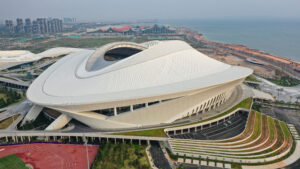
For the Leshan Olympic Center — 46,000 square meters of membrane, 30,000 seats, the main venue for the Sichuan Provincial Games — the design life and fire rating requirements dictated PTFE rather than PVDF. But for a PVDF tensile membrane project at comparable scale with a 25-year design horizon, non-weldable PVDF would be the only sensible specification. For a parking garage shade canopy with a ten-year planned service life, weldable PVDF tensile fabric is entirely appropriate. The right PVDF grade is the one that matches your project’s actual requirements — not your supplier’s margin.
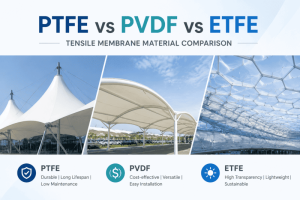
PVDF vs PTFE vs ETFE: Comparing Tensile Membrane Materials for Architecture
All three materials have legitimate places in tensile membrane architecture. We work with PVDF, PTFE, and ETFE regularly, and our project portfolio includes major installations in each material. The question is which tensile membrane material fits your specific project parameters.
| Factor | PVDF Tensile Fabric (Polyester + PVC + PVDF) | PTFE Membrane (Glass Fiber + Teflon) | ETFE Film (Fluoropolymer) |
|---|---|---|---|
| Service life | 10–25 years | 30+ years | 25+ years |
| Relative cost of tensile membrane | Low to medium | High (4–5× PVDF) | Medium to high |
| Color options for membrane | Wide — white, cream, blue, green, red, custom | White and off-white only | Clear, frit-printed patterns available |
| Light transmission | 5–8% (soft diffused light) | 10–20% (diffused) | Up to 95% (transparent grade) |
| Fire rating | B1 (flame-retardant) | A1 (non-combustible) | B1 (flame-retardant) |
| Foldable for transport? | Yes — PVDF membrane folds for container shipping | No — glass fiber yarns crack if bent | Yes — ETFE film can be rolled |
| Field repairability of membrane | Good — on-site high-frequency welding | Difficult — specialized hot-wedge tools required | Moderate — patch welding possible |
| Fabrication difficulty | Moderate — mature PVDF processing technology | High — requires specialized glass-fiber equipment | Moderate |
When to Choose PVDF, PTFE, or ETFE for Your Tensile Structure
For the Baiyun Airport T3 terminal canopy — 94 tensile membrane units, nearly 17,000 square meters, a permanent landmark at one of China’s busiest aviation hubs — we specified German-imported PTFE membrane. The project required a 30-plus-year design life and A1 non-combustible material classification. PTFE tensile fabric was the only material that met both requirements simultaneously.
For the Uzbekistan Ahangaran brick factory — 48,800 square meters of industrial tensile membrane roofing — we used German-imported PVDF tensile fabric. The project’s core requirement was cost-effective coverage of an enormous industrial span under Central Asian climate extremes, with winter lows below −20°C and summer highs above 40°C. PVDF membrane delivered the right performance-to-cost balance for that application.
ETFE film comes into its own for projects where transparency is the primary design driver. Our Huangshan Huashan Mysterious Grotto art installation used double-layer ETFE air cushions because the architectural intent was about light, translucency, and organic sculptural form — effects that a fabric PVDF or PTFE membrane cannot achieve.
The straightforward decision framework:
PVDF tensile fabric wins on value and design flexibility. PTFE membrane wins on permanence and fire performance. ETFE film wins on transparency. Most of the tensile membrane projects built each year are PVDF, and that is not a coincidence — PVDF tensile fabric fits the broadest range of applications at the most practical installed cost. For a side-by-side breakdown of how these three materials compare across composition, lifespan, cost, and application suitability, read our dedicated guide: Membrane Material Evolution: PTFE, PVDF & ETFE Compared.
How PVDF Tensile Fabric Is Manufactured and Installed on Site
Understanding the PVDF tensile membrane production and installation sequence helps project stakeholders set realistic procurement timelines and budgets. Many project delays originate from assumptions about fabrication lead times that don’t match how PVDF membrane manufacturing actually works.
Factory Production: From Polyester Yarn to PVDF Tensile Membrane
1. Yarn weaving
High-tenacity polyester yarns are woven into the base fabric on industrial looms. Tension control in both warp and weft directions at this stage directly determines the biaxial tensile properties of the finished PVDF membrane — this cannot be corrected later in the process.
2. PVC coating application
The woven polyester fabric passes through a coating line where liquid PVC plastisol is applied in precisely controlled passes, then thermally cured through gelation. For architectural-grade PVDF tensile fabric, complete yarn encapsulation is mandatory — any exposed polyester fiber is a potential failure initiation point under long-term weathering.
3. PVDF topcoat lacquering
The PVDF fluoropolymer topcoat is applied as a solvent-based lacquer to the outer face of the PVC-coated fabric, then oven-cured. For non-weldable PVDF tensile fabric, the topcoat covers the full surface. For weldable grades, the PVDF formulation and application process are adjusted to retain surface weldability.
4. Quality control testing
Every production batch of PVDF tensile membrane undergoes tensile testing, tear resistance testing, coating adhesion testing, and visual surface inspection before release for fabrication.
On-Site Fabrication and Installation of PVDF Membrane Structures
1. Patterning and CNC cutting
The structural engineer’s form-finding analysis defines the three-dimensional tensile membrane surface. This surface is divided into fabricatable flat panels, and CNC cut files are generated for each panel. Seam allowances — typically 40 to 60 millimeters — are incorporated at this patterning stage.
2. High-frequency panel welding
Individual PVDF membrane panels are joined using high-frequency (HF) welding machines. The PVC coating layers fuse at the molecular level under the HF field — a properly executed PVDF tensile fabric weld is as strong as the base material itself.
3. Perimeter edge detailing
The edges of the assembled PVDF membrane receive welded-on keder rails, webbing belts, or steel connection plates, depending on the attachment system designed for the specific tensile structure.
4. Installation and tensioning
The completed PVDF tensile membrane is transported to site, unfolded, connected to the structural steel or cable support system at designated attachment points, and tensioned to the engineered prestress level — typically 2 to 5 kilonewtons per meter for PVDF tensile fabric. Tensioning is the moment the PVDF membrane transforms from a flexible fabric sheet into a stiff, structurally active surface capable of resisting wind and snow loads.
PVDF Tensile Membrane Maintenance and Expected Service Life
How Long Does PVDF Tensile Fabric Last?
PVDF tensile fabric service life depends primarily on the quality and concentration of the PVDF topcoat, the local climate, and the exposure environment. Based on our direct experience with completed tensile membrane projects:
- Non-weldable PVDF tensile fabric (high PVDF concentration): 15 to 25 years under normal environmental conditions
- Weldable PVDF tensile fabric (low PVDF concentration): 10 to 15 years
- Acrylic-lacquered PVC membrane without PVDF topcoat: we have observed surface failures at the five-year mark
The life-limiting mechanism for PVDF tensile fabric is gradual weathering erosion of the PVDF topcoat — microns per year. When enough topcoat has eroded, the underlying PVC coating begins receiving direct UV radiation exposure. The first visible indication is yellowing of what should be a clean white PVDF membrane surface, followed by surface chalking, and eventually embrittlement of the PVC layer. At that stage, the PVDF tensile fabric should be scheduled for replacement.
Maintenance Best Practices for PVDF Membrane Structures
Cleaning frequency for PVDF tensile fabric depends on the site environment:
- Urban and industrial locations: professional membrane cleaning every 12 to 18 months. Airborne hydrocarbons and particulate matter accumulate faster than rainwater alone can remove from the PVDF surface.
- Suburban and rural locations: cleaning every 2 to 3 years is typically sufficient for PVDF tensile membranes.
- Coastal environments: annual inspection for salt deposit accumulation on the PVDF fabric; cleaning scheduled as needed.
The correct cleaning method for PVDF tensile fabric is low-pressure water spray with a mild, pH-neutral detergent. High-pressure washers operated at close range, abrasive cleaning compounds, and strong solvents will damage the PVDF topcoat and accelerate the very surface degradation they are intended to address.
Warning Signs Your PVDF Membrane Needs Attention
If you observe any of the following on a PVDF tensile fabric surface, the membrane topcoat is degrading:
- White powder visible when the PVDF membrane surface is rubbed (chalking)
- Yellowing or browning discoloration on what should be a clean white tensile fabric
- Loss of surface gloss — the PVDF membrane developing a matte, rough texture
- Water no longer beading on the PVDF tensile fabric surface
- Visible seam creep or delamination at PVDF membrane weld joints
Applications of PVDF Tensile Fabric in Architecture and Construction
PVDF tensile fabric has been installed across a broad spectrum of building types and climate zones. These are not hypothetical use cases — they are project categories where our company has directly designed, fabricated, and installed PVDF membrane structures.
Sports Facilities and Stadium Tensile Membrane Structures
The Jing Shan International Tennis Center — 22,800 square meters of membrane, 5,235 spectator seats — specified imported German PTFE membrane for the main competition roof and PVDF tensile fabric for secondary entrance canopies and pedestrian walkway covers. Tennis venues illustrate an important principle in tensile membrane material selection: the center court roof demands the highest-specification material, but the secondary structures benefit from the cost-performance balance that PVDF tensile fabric provides. For more examples, browse our stadium tensile membrane structures product page.
Swimming pool tensile membrane enclosures represent another strong PVDF application. The PVDF fluoropolymer surface resists chlorinated air — a known corrosive agent in indoor aquatic facilities — while the 5–8% diffused light transmission through PVDF tensile fabric provides soft natural daylight without the harsh glare and solar heat gain of transparent roofing systems.
Commercial PVDF Tensile Fabric Canopies and Retail Spaces
Shopping mall atriums, hotel entrance canopies, restaurant terraces, and open-air retail corridors are PVDF tensile fabric’s natural territory. The availability of PVDF membrane in multiple standard architectural colors — white, cream, light grey, blue, green, and red — means the tensile fabric can be matched to a commercial brand identity. PTFE membrane, restricted to white, cannot serve this design requirement.
We completed the Hangzhou West Lake Intime tensile membrane canopy in PVDF. In a high-visibility commercial retail setting, the PVDF fabric’s appearance directly shapes the customer’s perception of the space — and the membrane needs to maintain that appearance for years, not months. Another example is our Hangzhou Halo Dream Center commercial plaza project — a U-shaped tensile membrane installation within a 170,000-square-meter commercial complex — which demonstrates how far membrane technology has evolved for high-end retail environments.
Transportation Infrastructure Tensile Membrane Projects
Airport terminal canopies, railway station platform covers, bus terminal roofs, and parking structure shade canopies subject PVDF tensile fabric to the harshest operational conditions in the building industry — continuous structural vibration, diesel exhaust particulate deposition, and 24-hour operation with minimal maintenance access windows.
Our involvement in the Guangzhou Baiyun Airport T3 tensile membrane project — for which we supplied PTFE membrane for the primary canopy — informs our approach to transport-sector PVDF applications. For secondary transport hub canopies where A1 non-combustible classification is not mandatory, properly specified and maintained PVDF tensile fabric has a proven 15 to 20-year service record.
Cultural and Public PVDF Membrane Buildings
Museums, exhibition centers, theaters, and performing arts venues increasingly specify PVDF tensile fabric for its capacity to generate dramatic, fluid architectural geometries. The tensile membrane aesthetic — sweeping hyperbolic paraboloids, saddle surfaces, and conical tension forms — communicates spatial openness and contemporary design intent in ways that conventional rigid roofing cannot replicate.
Landscape and Urban PVDF Tensile Structures
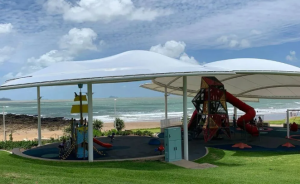
Plaza shade canopies, pedestrian walkway covers, park pavilions, and scenic area tensile membrane installations form a rapidly expanding application category. Municipal clients value PVDF tensile fabric structures because they deliver functional shade provision, architectural presence, and favorable installed cost relative to traditional built shade structures — all with a 15 to 20-year design life.
Industrial PVDF Tensile Fabric Roofing Applications
The Uzbekistan Ahangaran brick factory project — 48,800 square meters of German PVDF tensile fabric roofing — demonstrates PVDF membrane at industrial scale. The application had no aesthetic requirements whatsoever. The performance requirements were: cover a massive industrial span cost-effectively, survive Central Asian seasonal temperature swings from sub-zero winters to 40°C-plus summers, and perform maintenance-free for at least a decade. PVDF tensile fabric met all parameters at an installed cost that made the project commercially viable.
Is PVDF Tensile Fabric Right for Your Project? Making the Final Material Decision
After nearly twenty years of specifying, fabricating, and installing tensile membrane structures — over three million square meters across multiple continents and climate zones — we have developed a straightforward decision framework for PVDF vs PTFE vs ETFE material selection.
Choose PVDF tensile fabric
when your project needs a proven, cost-effective tensile membrane with a 15 to 25-year design life, architectural color flexibility, and straightforward fabrication and installation using mature, widely available processing technology. This description matches the majority of tensile membrane structures built globally each year — commercial canopies, sports facility roofs, transport hub secondary structures, landscape shade installations, and industrial tensile fabric roofing.
Choose PTFE membrane
when your project requires a 30-plus-year design life, A1 non-combustible fire classification, and the lowest possible long-term maintenance burden — and the project budget can support a premium tensile membrane material at roughly four to five times the cost of PVDF. International airport terminals, Olympic stadiums, major convention centers, and permanent landmark public buildings are the classic PTFE tensile membrane applications.
Choose ETFE film
when transparency, daylight transmission, and visual lightness are the primary architectural drivers — and your project team is prepared to design, install, and maintain the pneumatic air cushion systems that multilayer ETFE enclosures require. Botanical gardens, swimming pool atriums, and transparent building facades are the natural ETFE applications.
Every successful tensile membrane structure begins with the right material decision. Our experience has taught us that material selection is not about identifying the single “best” tensile fabric — there is no such thing. It is about identifying the right membrane material for your project’s specific span geometry, local climate conditions, construction budget, design life requirement, and aesthetic objectives. For a detailed, step-by-step framework covering budget, climate, and design life considerations for each material type, read A Complete Guide to Membrane Structure Material Selection.
For PVDF tensile fabric — the workhorse material of the tensile architecture industry — the decision almost always comes down to this: it is the membrane that offers the widest envelope of acceptable performance at the most practical installed cost for the broadest range of real-world projects. That is not a compromise position. It is why PVDF tensile fabric remains, project after project and year after year, the most widely installed architectural membrane in the world.
If you’re working through a material decision for a specific project, we’re happy to talk it through. Yexing has been designing and installing tensile membranes since 2008 — stadiums, airport terminals, commercial atriums — over three million square meters across four continents. Contact Yexing for a consultation.
FAQ
PVDF is polyvinylidene fluoride — a high-performance fluoropolymer containing carbon-fluorine bonds. In tensile membrane applications, it is applied as a thin protective topcoat to the outer surface of PVC-coated polyester fabric. The same PVDF fluoropolymer chemistry is used in premium architectural metal cladding coatings, aerospace components, and lithium-ion battery binders.
No — and this is the single most frequent confusion we encounter when discussing tensile membrane materials. PVDF tensile fabric is a three-layer composite: polyester woven base + PVC waterproof coating + PVDF fluoropolymer topcoat. PVC fabric without the PVDF topcoat exists on the market and is significantly cheaper, but its outdoor service life and surface performance are substantially inferior. When a specification says “PVDF membrane,” it is calling for the complete three-layer PVDF tensile fabric system.
Installed PVDF tensile membrane costs vary significantly with project scale, geometric complexity, and geographic location. For rough order-of-magnitude budget planning: a PVDF tensile fabric system typically costs 20 to 30 percent of an equivalent PTFE membrane system. For a project-specific estimate, provide your drawings and performance requirements to a qualified tensile membrane manufacturer.
Yes — and field repairability is a genuine practical advantage of PVDF tensile fabric over PTFE membrane. Small punctures and localized tears in PVDF membrane can be repaired on site using portable high-frequency welding equipment. Larger damaged sections can be cut out and replaced by welding in a new PVDF fabric panel. PTFE membrane repairs require specialized hot-wedge welding tools and PTFE-compatible repair materials, and the glass-fiber base fabric is considerably less forgiving to work with.
Standard architectural colors for PVDF tensile membrane include white, cream, light grey, blue, green, red, and sand. Custom color matching is achievable for larger PVDF projects. White PVDF tensile fabric remains the most commonly specified color because of its solar reflectivity and clean architectural appearance. Color availability is one area where PVDF tensile fabric has a clear advantage over PTFE membrane, which is limited to white and off-white.
Tensile membrane architecture in general offers meaningful environmental advantages compared to conventional rigid roofing: the lightweight PVDF fabric reduces structural steel and foundation requirements, which lowers the embodied carbon of the building; the translucency of PVDF membrane reduces daytime artificial lighting energy consumption; and at end of service life, the polyester and PVC components of PVDF tensile fabric are potentially recyclable through established PVC recycling streams. The PVDF topcoat is chemically stable under normal service conditions and does not leach substances into the environment.

She has over 20 years of experience in tensile membrane structure design, engineering, and manufacturing, with extensive expertise in delivering custom solutions for commercial and architectural projects.