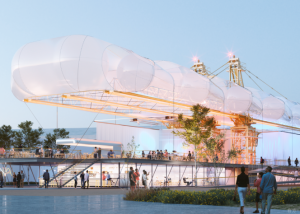
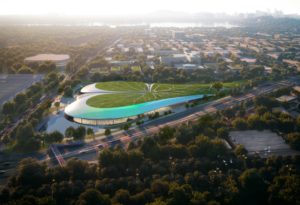
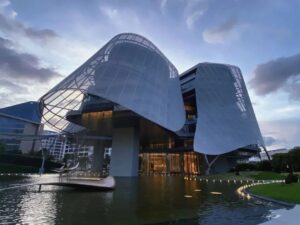
Membrane structure buildings are one of the most representative and promising architectural forms in the 21st century. They have broken the pattern of pure linear architectural styles
With its unique and elegant curved shape, it presents a gentle and powerful beauty, while also providing designers with more imagination and creative space.
Today, let’s share a type of membrane structure – the inflatable membrane structure.
What is an inflatable membrane structure?
Inflatable membrane structures are an important branch of lightweight spatial structures. Through the pressure difference of air, the flexible membrane structure system achieves the required rigidity to maintain the shape required by the design and even achieve large spans.
- Types of membrane materials
Membrane material is the main material of inflatable membrane structures, playing a role in sealing and bearing, which determines the application and safety performance of inflatable membrane structures. There are many types of membrane materials.
① Fabric-based membrane materials
② Thermoplastic polymer membrane materials
③ Other membrane materials
For instance, flexible solar cells can be combined with membrane materials to form membrane materials capable of generating electricity, super-soft and repeatedly foldable expanded polytetrafluoroethylene fiber membrane materials, and various grid membrane materials with light transmission and air permeability, etc.
- Types and composition of cables
The cable is composed of the cable body and the anchor. In air-supported membrane structures, the cable body often adopts steel wire rope, steel strand and non-metallic cable body, etc. - Classification and Characteristics of Inflatable Membrane Structures
Buildings composed of inflatable membrane structures can be divided into two major categories: one is the air-supported membrane structure, which is commonly seen in the industrial field.
Another type is the air-expanded membrane structure (air-ribbed type, air-pillow type, and airbag type are more suitable for application in public buildings).
Characteristics of air-supported membrane structures
The air-supported membrane structure is the only one that uses air as the support system.
A. Good economic performance: Low cost, saving the cost of support systems and foundation treatment. Its cost is usually only about 50% of that of conventional structures. (For reference only. The specific price still needs to be confirmed with the manufacturer according to the actual situation.)
B. Meeting the demands of large spans and large Spaces, high safety: Air-supported membrane structures have excellent spanning capabilities. As they do not require internal supports, they can create unobstructed large-span Spaces. Moreover, the air-supported membrane structure is very light in weight (about 3 kilograms per square meter).
C. The construction period is short. The processing and manufacturing of the air-supported membrane structure that can be disassembled and moved as a whole can all be completed in the factory, and only installation work is required on site. Generally, from design, equipment procurement to processing and manufacturing, it only takes 2 to 3 months to complete. It can provide a fast and convenient large-span architectural space for holding large-scale events and temporary exhibition halls.
D. Energy-saving and environmentally friendly, with strong applicability. The energy-saving effect is mainly based on the air tightness, insulation and light transmission of this type of building. The membrane material itself can be recycled and reused. During the construction and dismantling process, there is almost no construction waste or environmental pollution, and it has a very good environmental protection effect.
A. The building has an elegant shape and superior physical functions
B. The structural system is lightweight and convenient for construction and installation
C. Energy-saving and environmentally friendly, easy to maintain and service
D. Excellent fire resistance
E. Long service life
- The difference between inflatable membrane structures and membrane structures
Inflatable membrane structures are a type of membrane structure. Both are constructed using membrane materials. The main differences between them lie in the support methods and installation methods. Membrane structures are mainly composed of membrane materials, steel cables and pillars. Through the stretching effect of the steel cables, the membrane materials form tension to achieve a fixed structural form.
Inflatable membrane structures, on the other hand, achieve stable shapes through pressure differences. For instance, single-layer inflatable membrane structures must be enclosed Spaces and need to be constantly inflated to maintain a certain pressure difference between the inside and outside to preserve their shapes. In contrast, inflatable membrane structures can be directly used as structural components
- Advantages and Disadvantages of Inflatable Membrane Structures
The greatest advantage of inflatable membrane structures lies in their convenient installation and economic cost. They are especially suitable for large-span working Spaces and can achieve curved and flexible postures that traditional buildings cannot reach.
However, compared with tensioned membrane structures and air-expanded inflatable membrane structures, air-supported inflatable membranes require the installation of an inflation control system and equipment. The larger the single-layer inflatable membrane structure, the more professional equipment is needed and the more complex the commissioning process is required to be realized.
#tensile membrane #Air membrane

She has over 20 years of experience in tensile membrane structure design, engineering, and manufacturing, with extensive expertise in delivering custom solutions for commercial and architectural projects.