The National Energy Administration announced that the social electricity consumption in the first half of 2023 was 4,307.6 billion kilowatt-hours, an increase of 5% year-on-year. Among them, the electricity consumption for cooling has accounted for more than 15%, which is closely related to the strategic goals of peaking carbon emissions and achieving carbon neutrality. Therefore, giving priority to passive cooling technologies is crucial for achieving net-zero emissions by 2050. Passive daytime radiant cooling (PDRC) is a zero-energy alternative cooling technology that is both environmentally friendly and provides effective cooling at temperatures lower than the ambient temperature. PDRC is achieved by effectively reflecting sunlight in the 0.3-2.5μm band and emitting strong long-wave infrared (LWIR) radiation into the cold 2.7K outer space through an atmospheric transparent window (within the 8-13μm wavelength range). In recent years, PDRC technology has been widely applied in radiant condensers, optoelectronics, personal thermal management, electronic heat dissipation, flexible coatings and construction. PDRC devices and systems have been successfully produced by simultaneously introducing solar irradiation to suppress and enhance thermal infrared emission through methods such as multilayer photonic structures, metamaterials, random media, aerogel structures, hydrogels, and porous polymer structures. However, most cooling structures require complex or expensive technologies to implement, which makes industrialization challenging. In addition, the mechanical properties (such as elasticity, toughness, Young’s modulus), long-term durability, and limited working temperature, especially the particularly poor self-cleaning property, make it difficult for the existing materials to develop in practical applications. Therefore, it is still advisable to develop long-term self-cleaning PDRC materials with simple, efficient, scalable strategies and cooling performance.
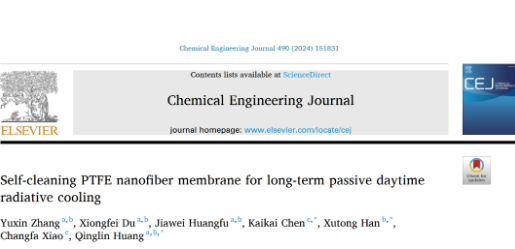
Recently, a team led by Professor Huang Qinglin from Tianjin Polytechnic University and a team led by Associate Professor Chen Kaikai from Shanghai University of Engineering Science have developed a simple, efficient and scalable strategy for preparing superhydrophobic polytetrafluoroethylene (PTFE) nanofiber membranes (SNM-PTFE). These membranes exhibit excellent radiative cooling and self-cleaning properties and are suitable for various practical applications. The average infrared emissivity of SNM-PTFE is 95.8%, and it reflects 95.4% of solar irradiance. Under direct sunlight, its low-temperature cooling performance is approximately 14.4 ℃. In addition, it also demonstrates outstanding cooling performance above the ambient temperature, reducing the temperature by approximately 9.5 ℃ under sunlight, and showcases unprecedented heat dissipation and solar insulation performance. The self-cleaning surface of SNM-PTFE still maintains good cooling performance after being exposed outdoors for one month. SNM-PTFE has shown great prospects in PDRC and can further expand its application in residential, industrial applications and human thermal management. The related achievements are titled “Self-cleaning PTFE nanofiber membrane for long-term passive daytime radiative cooling”. Published in “Chemical Engineering Journal” (Journal Number: Chemical Engineering Journal 490 (2024) 151831 IF=15.1).
The original link: https://doi.org/10.1016/j.cej.2024.151831
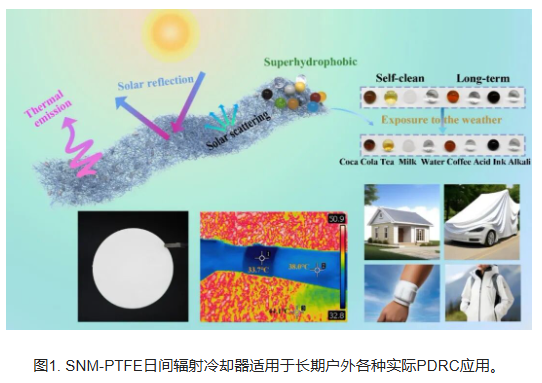
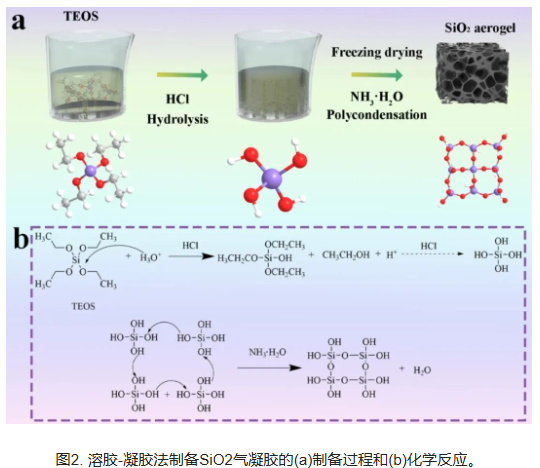
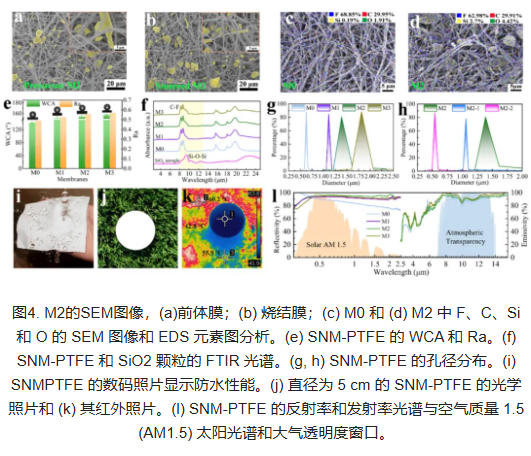
In conclusion, the high performance of self-cleaning PDRC SNM-PTFE has been successfully prepared for long-term use in various outdoor scenarios. This innovative SNM-PTFE enhances its heat insulation performance and exhibits an excellent solar reflectance of 95.4% and a mid-infrared emissivity of 95.8% with an average pore size of approximately 1.0 μm. The outdoor experimental results show that by increasing the thickness of SNM-PTFE and incorporating SiO2 particles, the cooling performance of SNM-PTFE can be significantly enhanced. More importantly, under direct sunlight in natural weather conditions, the average temperature drops by approximately 14.4 ℃ below the ambient temperature and by about 9.5 ℃ above the ambient temperature. Furthermore, even when exposed to outdoor conditions for a full month, SNMPTFE still maintains its outstanding cooling performance, demonstrating its excellent long-term durability and self-cleaning properties. Its outstanding comprehensive performance makes it a promising candidate material for efficient cooling in residential, industrial applications and human thermal management, which can significantly reduce carbon emissions and energy consumption.
Yexing membrane structure
Yexing Membrane solutions for your building needs
fabric structure engineering case
fabric structure engineering
membrane structure engineering
high-tech architectural membrane

She has over 20 years of experience in tensile membrane structure design, engineering, and manufacturing, with extensive expertise in delivering custom solutions for commercial and architectural projects.